Material names in the lash market can be confusing. Terms such as silk, mink, faux mink and cashmere often describe a visual finish or product family rather than a universally standardized fiber formula. Two trays carrying the same marketing name can feel and perform differently because the fiber, taper, heat setting, surface finish and strip construction are different.
For a wholesale buyer, the right question is not “Which material name is best?” It is “Which measurable specification produces the look and working behavior our customers need?”
What are professional lash extensions commonly made from?
Most modern professional lash extensions are made from synthetic fibers, with PBT widely used across the industry. Synthetic fibers can be engineered for consistent diameter, curl, color and taper, but the finished result still varies among suppliers and production methods.
Marketing names do not guarantee a specific performance. A product sold as “silk” may be glossier and firmer in one range, while another supplier uses the name for a softer semi-matte line. “Cashmere” may refer to a light, dark, matte product or to a particular profile. “Mink” and “faux mink” are also used differently across brands. Buyers should therefore request the actual fiber declaration and evaluate samples instead of approving a bulk order from the product name alone.
The six material characteristics buyers should specify
1. Black level and surface finish
Some collections need a deep matte black for a dense effect. Others use a controlled sheen to keep individual fibers visible. Compare samples under daylight and the lighting commonly used by your customers. Photography can exaggerate or hide gloss, so a physical sample remains important.
2. Softness and spring
Softness affects the perceived quality of the tray and the client experience, while spring influences how the fiber handles and maintains its form. A fiber can feel soft but still have enough resilience for professional pickup. Ask lash artists to compare samples using the intended technique rather than evaluating them only by touch.
3. Diameter and weight
Diameter is a product specification, while final weight also depends on length, taper and profile. Classic and volume techniques require different diameter ranges. Do not substitute one diameter for another without reviewing how the change affects the intended set and the natural lash assessment performed by the technician.
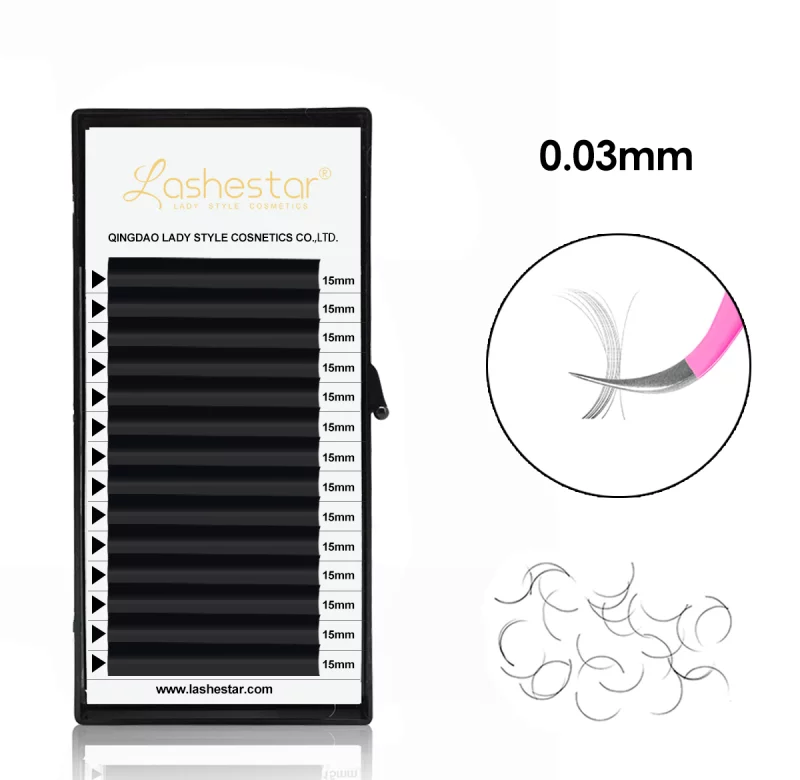
Lashestar’s catalog includes multiple classic diameters, such as 0.03 mm classic lashes, as well as volume, easy fan, premade fan and specialty extension ranges for sample comparison.
4. Taper and profile
The taper affects visual softness, attachment area and how heavy the tip appears. A round fiber, flat profile or other shaped profile can create a different appearance even when the stated width is similar. Include close-up images or an approved sample when profile is part of your brand promise.
5. Curl consistency
Curl labels are not perfectly standardized between manufacturers. The same letter can look different because of the forming tool and production settings. Test the exact curl, diameter and length combination you plan to sell. Confirm that mixed trays remain consistent from the shortest to the longest rows.
6. Strip and pickup behavior
The backing strip is part of the working product. Its tack, surface, width and position affect how easily artists remove fibers and create fans. A beautiful fiber can still frustrate technicians if it releases poorly or leaves residue. Include pickup and fanning tests in the sample review.
How material requirements change by product type
Classic lash extensions
Classic ranges usually prioritize consistent individual fibers, predictable curl, a clean taper and easy pickup. The desired finish depends on the brand position: soft natural sets may use a lower-shine appearance, while bold lines may use a darker or more polished finish. Build a diameter and length matrix around the services your buyers actually perform.
Volume and easy fan lashes
For handmade volume, technicians assess how the fibers spread, remain aligned and release from the strip. Easy fan products add construction features intended to help form a fan, so sample testing should check the base, opening behavior and consistency across rows. The fiber name alone does not describe these working characteristics.
Premade fans
Premade fans require consistent fan width, symmetry, base construction, curl and weight. Compare the number of fibers, stem length and opening shape. Ask for a clear product specification because two products described as the same dimension can create different final looks.
Colored and specialty extensions
Color consistency, fade behavior and finish become additional checkpoints. Review the sample against an agreed color reference under more than one lighting condition. For multi-color or effect ranges, approve the assortment ratio as well as each individual color.
A practical sample test for lash brands
Prepare a scorecard and have more than one experienced user test each coded sample. Keep the supplier name hidden during the first comparison if you want to reduce bias.
- Visual check: compare black level, shine, taper, curl and row consistency.
- Pickup check: remove fibers from different rows and record strip release.
- Technique check: create the intended classic, volume or premade-fan set.
- Wear and shape review: assess whether the selected curl and appearance suit the service after application.
- Packaging check: confirm that labels and tray markings match the sample.
Record the sample code, specification and date. If you request a change, alter one defined characteristic where possible. Comparing version A and version B is more reliable than giving a broad request for a softer or more premium product.
Questions to ask an eyelash extension manufacturer
- What synthetic fiber and profile does this range use?
- What do your silk, mink or cashmere names mean in measurable terms?
- Which curls, diameters and lengths are available for sampling?
- Can the black level, sheen, taper or strip be adjusted?
- How is curl and diameter consistency checked during production?
- Will repeat orders follow the approved sample and specification code?
- Which packaging and label options are available for private label orders?
Choose a specification, not a marketing label
A strong lash range gives buyers a repeatable experience. That comes from a written specification, physical sample, controlled approval process and batch checks. Use familiar material names to help customers navigate the range, but support those names with the curl, diameter, length, finish, profile and working behavior they can expect.
To compare fibers and extension constructions for a wholesale or private label project, select products from the Lashestar lash extension collection and send the factory team your target specification. Include the intended technique, market, quantity and packaging requirement so the sample recommendation can be specific.