
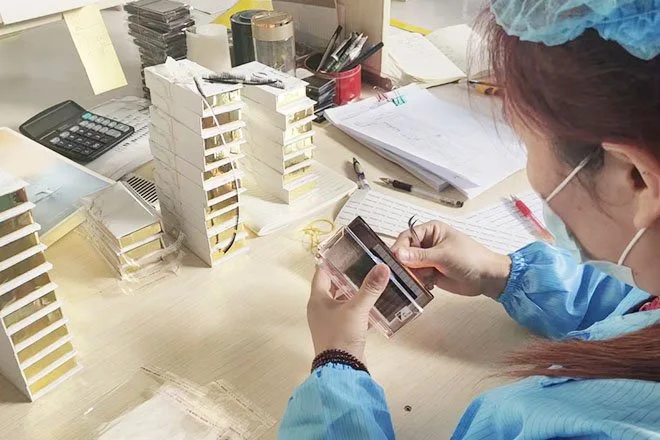
Knowing how eyelash extensions are manufactured helps wholesale buyers write better specifications and identify where quality problems can begin. The exact equipment and sequence vary by product, but professional production generally moves through material confirmation, fiber preparation, curl forming, assembly, tray packing and final inspection.
The most useful factory conversation connects every production stage to an approval point. Buyers should know what will be checked, which sample defines the standard and how the same specification will be repeated in a bulk order.
1. Confirm the product specification and approved sample
Production should start from a controlled specification. For individual extensions, that document may include fiber type or product family, surface finish, curl, diameter, length, taper, color, strip construction, rows per tray and packaging. Premade fans need additional details such as dimension, fan width, stem length and base style.
The specification should match a labeled physical sample whenever appearance or working behavior cannot be described by numbers alone. Both sides need to know which revision is final. Artwork, tray labels and cartons should use the same product names and codes.
2. Inspect incoming fibers and components
Raw and purchased components influence the finished product before assembly begins. A factory checks whether the fiber, tape, trays, boxes, labels and other components match the order. Color, surface, dimensions and visible condition are common incoming checkpoints.
For a private label order, this stage should also confirm that packaging components use the approved artwork and finish. A print error found before assembly is easier to correct than one found after thousands of units have been packed.
3. Prepare and arrange the fibers
Fibers are organized for the required product construction and cut or prepared according to the target lengths. Consistency matters because uneven lengths or mixed fibers will be visible in the finished tray. The factory uses the production specification to separate different curls, diameters and length groups.
At this stage, buyers should expect clear batch and specification identification. Similar-looking materials can be difficult to distinguish after processing, so production control should prevent components from different orders or variants being mixed.
4. Form and stabilize the curl
The prepared synthetic fibers are formed around tools selected for the target curl and processed under controlled conditions. Tool dimensions and process settings affect the resulting curve. Because curl letters are not perfectly standardized across the industry, the approved sample is an essential visual reference.
A useful in-process check compares the formed fibers with the approved curl at several lengths. Long and short fibers should belong to the same product family even though their curves may appear different when placed side by side.
5. Build the required lash construction
Individual extension lines are arranged for placement on the backing strip. Easy fan and other specialty products require their specified base behavior. Premade fans add a separate fan-forming and base-construction stage, where symmetry, fiber count, opening and stem length must remain consistent.
Many lash production tasks depend on trained manual work. Process instructions, approved samples and in-line checks help the production team repeat the buyer’s requirement across the order.
6. Assemble rows and trays
Finished lash rows are placed into trays according to the approved layout. Single-length trays must contain the declared length; mixed trays must follow the agreed assortment. Row labels, curl and diameter markings should be checked against the contents before the tray is closed.
Tray assembly is also a usability checkpoint. Strips should sit straight, labels should remain readable and products should be protected during normal handling. Random pickup tests can reveal strip-release problems that a visual inspection would miss.
7. Apply private label packaging
The product is packed into the approved box or other retail presentation. Operators check the brand, product name, specification, barcode and market information against the order. Inserts or accessories must be included in the correct quantity.
Packaging should protect the tray during storage and transport without making professional use difficult. Before bulk production, approve the physical fit as well as the graphic design. A visually attractive box is not successful if the tray moves, labels cover important information or the opening damages the product.
Quality control during lash manufacturing
Final inspection alone cannot control every source of variation. A stronger quality plan places checks at the stages where a problem can be corrected.
Incoming inspection
Confirm fibers, trays, strips, printed packaging and labels before they enter production. The scope should reflect the product and destination market. Documents or tests requested by the buyer must apply to the actual product, not only to the company in general.
In-process inspection
Check curl, length, diameter, appearance and construction while the order is being made. In-process checks reduce the risk of repeating a defect through an entire batch. For premade fans, include symmetry and base consistency; for individual extensions, include row uniformity and strip behavior.
Packaging and label inspection
Verify artwork version, product codes, declared specifications and packing quantities. Mixed variants should have controls that prevent the wrong tray entering the wrong box. Outer cartons and shipping marks should match the commercial documents.
Final random inspection
Samples from the completed order are compared with the agreed standard. The inspection can include appearance, dimensions, tray arrangement, pickup behavior, packaging condition and quantity. The buyer and manufacturer should agree in advance how samples are selected and how any nonconformity is handled.
A buyer’s quality-control checklist
- Is the final specification identified by a revision or product code?
- Is an approved physical sample available to production and inspection staff?
- Are curl, diameter, length and finish checked during production?
- Are strip release and other working behaviors tested, not just appearance?
- Do tray labels, retail packaging and carton labels match the contents?
- Are random finished units checked from more than one part of the batch?
- Is there a written process for changes, defects and repeat-order feedback?
How to work with a factory on the first bulk order
Send a complete brief and ask the factory to identify missing decisions before sampling. Review the sample with the people who will use or sell the product. Consolidate feedback into one marked revision, then approve the specification, sample and packaging together.
During bulk production, request updates at the milestones that matter to the project rather than relying on unstructured daily messages. If an approved component becomes unavailable, require a new approval before substitution. Keep a retained sample from the delivered order and use customer feedback to plan controlled improvements.
Lashestar operates in Qingdao, China, with around 200 factory workers supporting lash products and related private label projects. The About page shows the production environment and inspection work. To discuss a new extension range, review the wholesale lash extension catalog and send your specification and sample requirements to the factory team.