
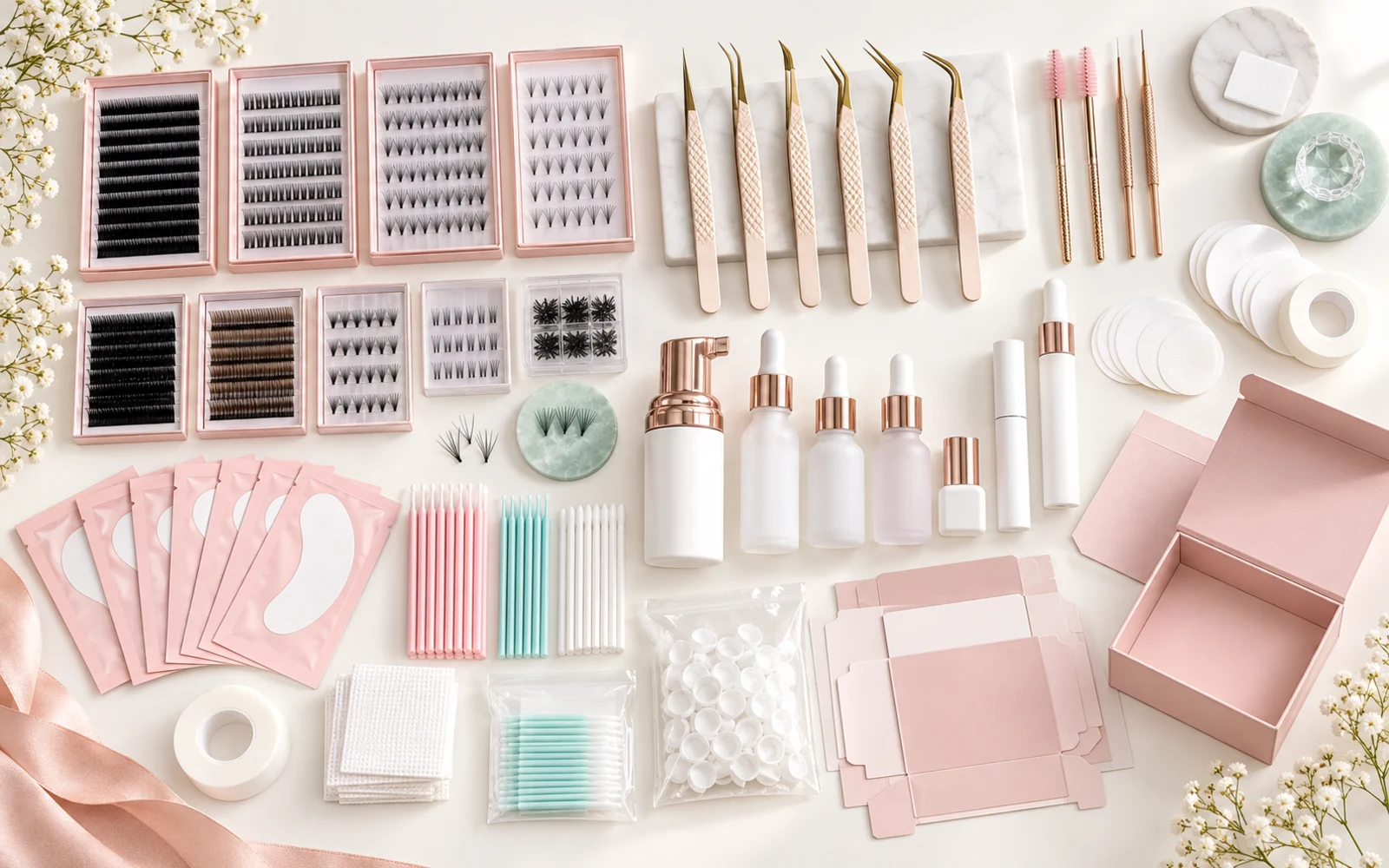
A lash extension kit can mean a professional service set, an academy training set, a salon opening pack or a consumer aftercare package. Those products should not share one vague contents list. Start by naming the user, skill level, job and sales channel.
Lashestar currently lists rose gold, white and pink lash extension kit directions plus a lash shampoo kit. The company also supplies extension trays, professional adhesives and salon tools and supplies. A buyer can combine those families only after checking compatibility, instructions and market requirements.
Four kit types with different rules
| Kit | User and job | Typical contents direction |
|---|---|---|
| Professional service kit | Trained lash artist performing a defined service | Approved trays, tools, professional liquids and station supplies with full documentation |
| Academy kit | Students under an educator’s programme | Course-matched practice materials, tools, controlled liquids and identification |
| Salon opening pack | Business equipping one or more workstations | Core tools plus replenishment quantities based on planned services |
| Retail aftercare kit | Consumer maintaining lashes under label directions | Compatible cleanser, brush, instructions and pouch; exclude professional-only chemicals |
Choose lash trays by range logic
Row count is only one tray field. Specify product construction, fiber, finish, curl, diameter, length sequence, strip behaviour, inner card and outer box. A 6-row trial tray and a 20-row salon tray can serve different commercial roles, but the exact row options depend on the product line.
- Trial or discovery: a compact mix that lets the buyer compare a defined product family.
- Core salon stock: high-use lengths and curls in a row count that fits service volume.
- Specialty set: a clear construction or curl story rather than miscellaneous slow-moving rows.
- Academy set: sizes that match the written curriculum and exercise sequence.
Use the lash curl and specification series to define curl, diameter, length and tray layout before quoting. Mixed trays should list the exact row sequence rather than “mixed length” alone.
Build the bill of materials
| Field | Decision | Approval evidence |
|---|---|---|
| Contents | Product code, version and quantity of every item | Signed bill of materials and assembled sample |
| User | Professional, student, salon buyer or consumer | Channel statement and instructions |
| Compatibility | Which liquids, trays and applicators are intended to work together | Current supplier documents and test record |
| Packaging | Insert, tray, pouch or box dimensions and protective structure | Filled transit sample |
| Labels | Identity, warnings, lot and responsible-party requirements | Market-reviewed final artwork |
| Replenishment | Which components are sold separately | SKU map, case packs and reorder plan |
Do not let the box hide the economics
Calculate landed cost by component, assembly, packaging, quality control and freight. Then model replacement sales. A low launch price can create poor economics when the kit contains too many slow-moving tools. A stronger B2B kit gives the buyer a clear initial setup and an obvious route to reorder trays, cleanser and disposables.
For salon groups, size the kit by workstations and monthly services. Durable tools are bought per station plus spares. Disposable stock is calculated from consumption. Adhesive and liquid quantities must reflect storage and opened-product instructions, not a desire to make the box look fuller.
Sample and transit approval
- Approve every component separately against its specification.
- Assemble a complete kit with final-size labels and inserts.
- Check that sharp tools and liquid containers cannot damage other contents.
- Run the agreed transit test in the sales carton.
- Verify barcode, count, lot relationship and market-language copy.
- Retain one assembled approval sample for bulk comparison.
Use one visual system across the range
Colour can distinguish rose gold, white and pink design stories, while typography, information hierarchy and SKU naming remain consistent. The front of the box should identify the kit’s job. The back or insert should list contents and user. Decorative language should not replace warnings or professional-use information.
For custom packaging and sample stages, review the Lashestar Private Label process. For recurring stock inside salon kits, use the disposables checklist. For adhesive selection, begin with the lash extension glue guide.
Range plans for three B2B buyer sizes
An independent professional may need one core tool set, a small number of proven tray specifications and realistic replenishment packs. A multi-chair salon needs standardized station tools, spare capacity and central stock. A distributor needs clear product tiers, retail-ready labels and case packs that its customers can reorder. Use those differences to build separate bills of materials rather than changing only the box colour.
For each plan, forecast the first 90 days. Separate durable items from consumables. Trays, liquids and disposables should have individual reorder codes so the customer does not repurchase a full kit to replace one item. That replenishment path is where a kit becomes a long-term B2B account rather than a one-off gift box.
Buyer questions about kits and trays
How many tray rows are best?
There is no single best count. Match row count to trial, salon and wholesale use, then confirm that the chosen product line supports it. Specify every row and label field.
Should a kit include every liquid?
No. Include only products needed by the defined protocol and user. More contents increase compatibility, training, shipping and compliance work.
Can professional and consumer kits share packaging?
They can share a brand system, but the product identity, contents, instructions and warnings must remain unambiguous. Visual similarity must not blur the intended user.
What should buyers approve first?
Approve the product specifications and contents before final box structure and artwork. Otherwise a late bottle or tray change can invalidate the insert, fit and shipping test.
To develop a professional, academy or aftercare kit, send Miya Chen the user, contents, target price, quantity, market and packaging direction.