Professional eyelash extension glue is a system product. Its behaviour depends on the formula, the room, the amount dispensed, the artist’s pickup and placement speed, and storage after opening. A buyer choosing glue for a salon chain or private-label range therefore needs more than a list of “fast” and “slow” products.
This guide sets out a practical approval method for products in the Lashestar adhesive collection. It does not turn a supplier’s marketing claim into a guarantee. Ask for the current label, technical data and safety data sheet for the exact sample, then test that sample in the environment in which it will be used.
Start with the service environment
Cyanoacrylate adhesive curing is affected by moisture. H.B. Fuller’s professional lash guidance describes core products designed around a 40–60% relative-humidity range, while also offering formulas for lower humidity. That is useful as a technical principle, but the working window for your product must come from its own current documentation.
| Input | What to record | Why it changes the decision |
|---|---|---|
| Room conditions | Typical and extreme temperature and relative humidity | A product that works in a controlled training room may behave differently in the real salon. |
| Artist speed | Time from pickup to placement and isolation workflow | An adhesive that cures before placement can reduce usable contact; one that remains wet can slow the service. |
| Service type | Classic, volume, premade or another defined technique | Pickup volume, fan behaviour and attachment method change the usable working time. |
| Ventilation | Local exhaust, room air change and workstation layout | Professional exposure control is part of the protocol, not a fragrance preference. |
| Storage | Unopened and opened storage, cap cleaning and replacement cycle | Heat, moisture and repeated opening can change product performance. |
Dry time is a workflow measurement
A “0.5–1 second” statement is only useful when the test conditions and application method are known. Faster is not automatically better. If the artist cannot place the extension within the adhesive’s usable window, the attachment may not match the approved sample. If the formula is too slow for the artist and room, adjacent lashes can remain at risk of sticking during the service.
Approve at least two candidate speeds. Use the same lash fiber, drop age, pickup method and room conditions. Record placement feel, fan closure, visible residue and the result of the brand’s normal wear-assessment protocol. Do not publish a retention period from one informal trial.
Colour and application route
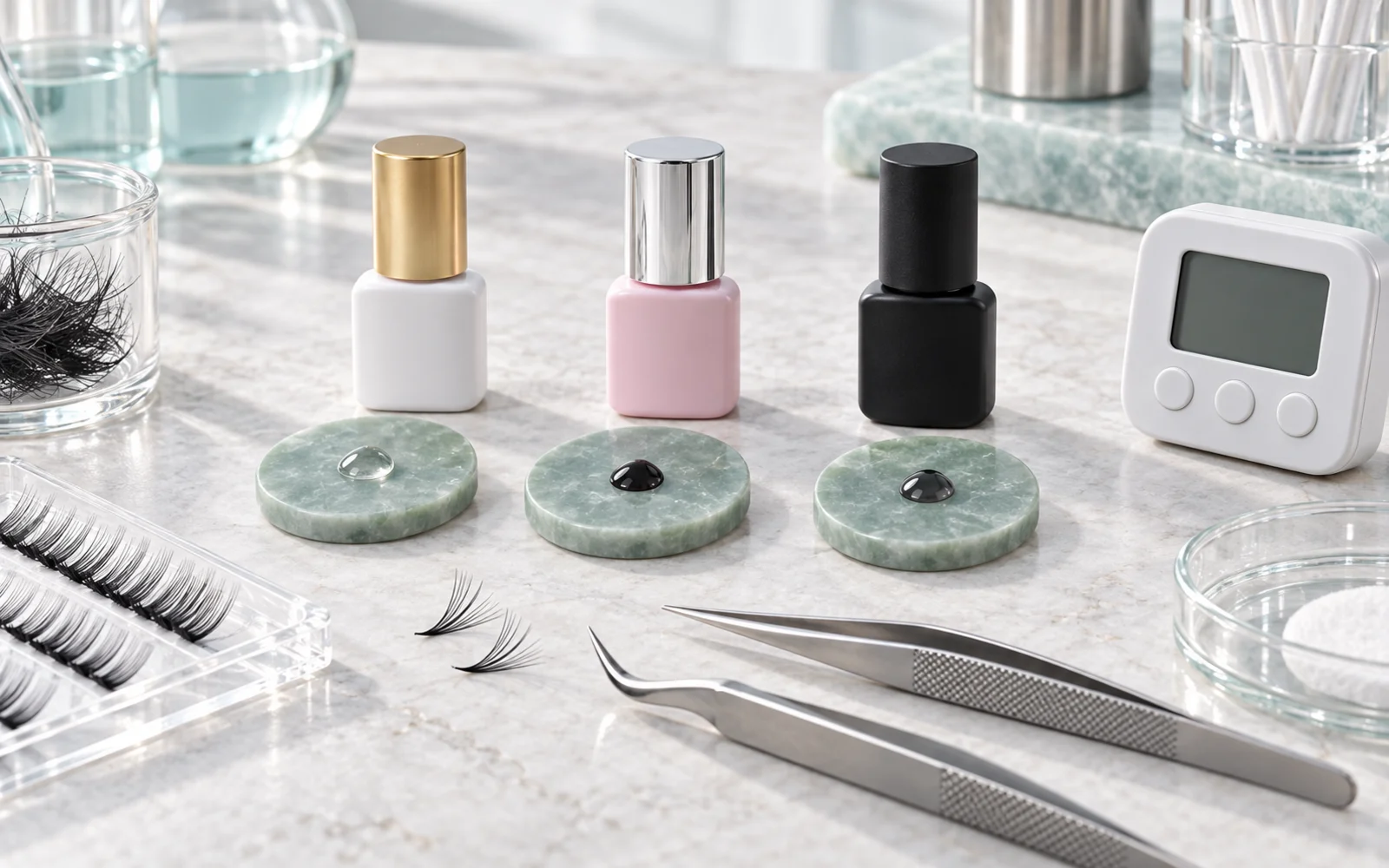
Black adhesive supports a conventional lash-line appearance. Clear adhesive can suit work where black pigment is not desired. Brown adhesive is a range-building option for softer colour stories. UV-curing systems are a separate application route and require compatible equipment, exposure controls, training and market-specific review; they should not be treated as a direct bottle-for-bottle substitute.
The current Lashestar catalogue includes numbered black adhesives plus brown, clear, UV and custom BN-1 options. These records establish the available product directions. Exact cure window, ingredients, pack size and storage instructions must be reconfirmed for the current production sample.
Build a supplier comparison that can be audited
| Field | Supplier document | Buyer verification |
|---|---|---|
| Formula identity | Product code, ingredient declaration and SDS | Match every document to the labelled sample. |
| Working window | Stated temperature and humidity range | Run controlled trials at the expected boundaries. |
| Cure speed | Defined test conditions | Test with representative artists and techniques. |
| Storage and shelf life | Unopened/opened instructions and lot marking | Plan receiving, stock rotation and salon replacement. |
| Packaging | Bottle, nozzle, cap, fill and label specification | Approve leak, dispensing and transit samples. |
| Claims | Current supporting evidence | Review wording for the country where it will be sold. |
Safety and professional controls
The FDA classifies eyelash extensions and their adhesives as cosmetic products in the United States and advises consumers to check ingredients because the eye area is delicate. NIOSH also identifies cyanoacrylates among work-related asthma exposures. A professional programme should therefore include ventilation, spill procedures, training, label and SDS access, and a process for recording adverse events.
Do not use “pregnancy safe,” “non-irritating” or similar medical-sounding absolutes without qualified evidence and regulatory review. Stop the service and follow the product instructions and appropriate medical guidance if irritation or another adverse response occurs.
Sample approval plan
- Send the supplier the room range, service types, artist speeds, desired colour, bottle size, market and claim requirements.
- Receive coded samples with current label, technical data and SDS documents.
- Test dispensing and application using a written protocol.
- Repeat at the expected temperature and humidity boundaries.
- Approve the formula, bottle, label and packaging as one controlled specification.
- Retain a signed sample and use a lot-based incoming check for bulk orders.
Use the primer, bonder and sealant guide to decide whether a prep or finishing product belongs in the protocol, then plan disposable supplies around the approved service.
Sources and verification
- FDA: Eye Cosmetic Safety
- H.B. Fuller: professional lash adhesive performance in low humidity
- CDC/NIOSH: work-related asthma exposures
How to run a four-week commercial trial
Begin with a small group of representative artists rather than the fastest technician in the business. Give each participant coded bottles, the same approved lash products and a simple log. Record room readings at the start and during each service, the time a fresh drop is dispensed, the technique, and any handling issue. This creates evidence the purchasing team can compare instead of a collection of impressions.
Review the trial weekly. Separate formula observations from storage or technique deviations. A bottle left open, an unclean nozzle or a room outside the documented window is an operational event, not proof that the formula itself failed. Equally, repeated difficulty inside the stated conditions should not be dismissed as artist error. The commercial choice needs to work for the normal team, not only under a supplier demonstration.
At the end of the trial, choose a primary adhesive and, only when the business case is clear, a second formula for a meaningfully different environment or artist speed. Too many near-identical adhesives make training, stock rotation and customer support harder.
Questions buyers ask before a bulk order
Can one adhesive cover every salon climate?
No formula should be assumed to cover every climate. Use the documented working range, the salon’s measured conditions and boundary testing. Where seasonal conditions move outside the range, improve environmental control or qualify a second product with a separate protocol.
Does low fume mean allergy free?
No. Odour or fume positioning is not a guarantee that a person cannot react. Request evidence for the exact claim, maintain exposure controls and use accurate label language.
How many bottle sizes should a private-label range launch?
Start with the size that fits realistic professional use after opening. A second size is justified when it serves a clear segment such as testing, training or higher-volume salons. Each size adds artwork, inventory and forecast requirements.
What should be included in the quote request?
Include destination markets, professional channel, expected monthly volume, artist speed, room range, preferred colour, bottle size, documentation, packaging, claims and sample deadline. That brief produces a more comparable quote than asking only for the “best glue.”
For a formula and packaging review, send Miya Chen your market, room conditions, artist profile, quantity and required documents.