
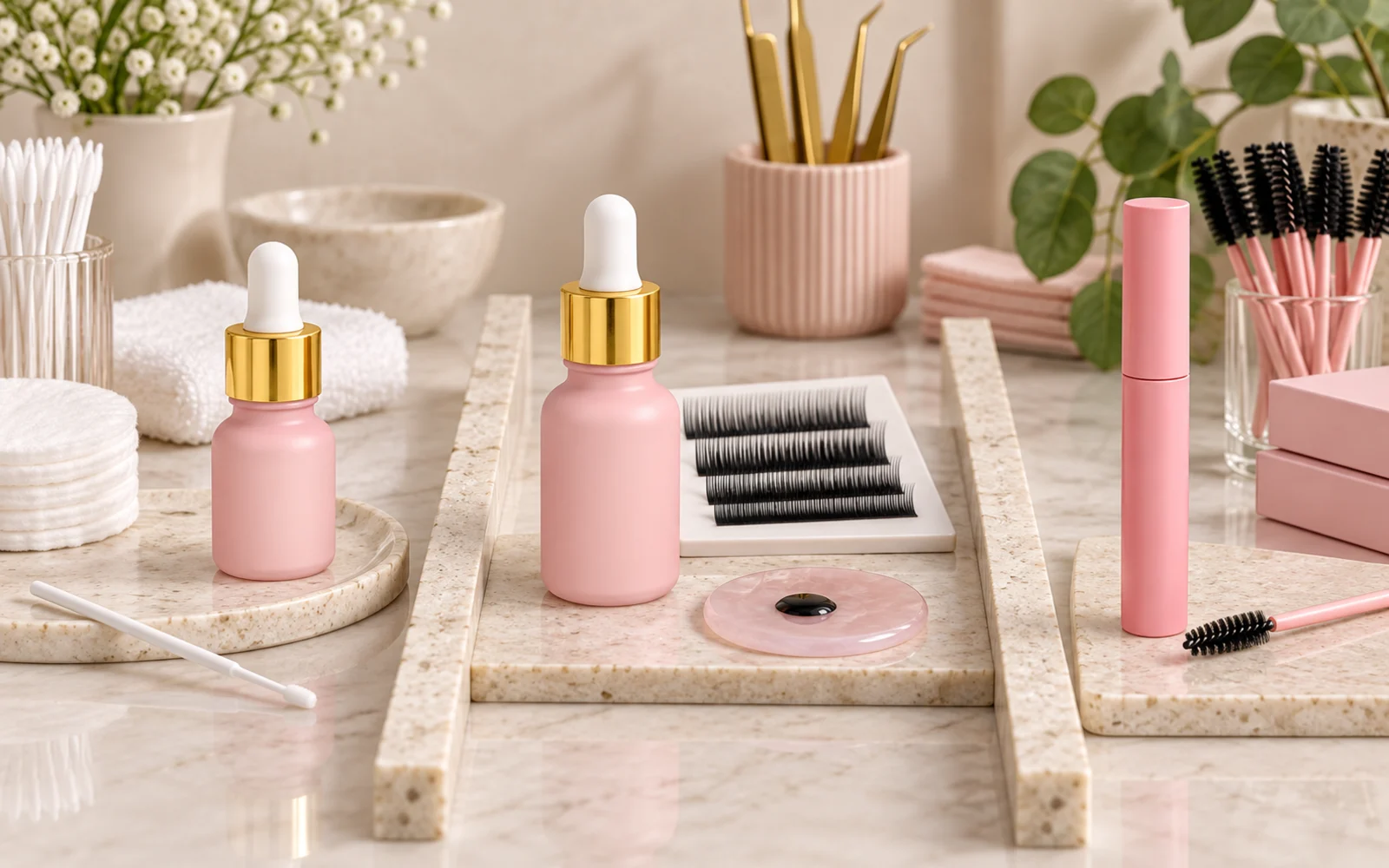
Primer, bonder and sealant are often sold as a three-product routine. That is a merchandising structure, not a universal technical rule. A salon may need one, more than one or none of them depending on its cleanser, adhesive, environment and written service protocol.
Lashestar currently lists primers in 5, 10, 15, 20 and 30 ml directions, bonders in 10, 15 and 20 ml directions, and a lash extension coating sealant in the salon supplies collection. The size list helps range planning. The role, ingredients, instructions and compatibility of every exact sample must still be verified.
Primer prepares the surface
A lash primer is generally positioned for a preparation step after cleansing. Its purpose may include removing remaining residue or supporting a defined surface condition before adhesive application. It should not be used to compensate for incomplete cleansing or applied by habit without reference to the product instructions.
When testing primer, use the same cleanser, lash fiber, adhesive and room conditions. Compare the approved protocol with and without the primer. Record whether it changes handling, visible residue or repeatability. Avoid a broad claim that primer “always improves retention”; compatibility and application amount matter.
Bonder belongs to a defined cure protocol
A bonder is commonly positioned for use after extension application to influence the final adhesive process or reduce tack under specified instructions. The timing and amount are product specific. Applying a generic liquid too early or too heavily can create a different result from the one the supplier tested.
The glue brief should therefore name the compatible bonder, application method and allowed interval. If the supplier cannot provide clear pairing and instructions, treat the combination as unverified until a controlled test is completed.
Sealant is a finishing or aftercare layer
A coating sealant is marketed as a protective finishing product. Its actual film, wear, removal and aftercare compatibility depend on the formula. Confirm whether it is intended for professional application, retail aftercare or both, and whether repeated use is part of the validated instructions.
| Product | Stage | Core buyer question | Common range error |
|---|---|---|---|
| Primer | Preparation | What surface condition does it address, and with which cleanser and adhesive? | Using it as a substitute for proper cleansing. |
| Bonder | After application, at a defined time | Which adhesive and protocol have been tested together? | Assuming every bonder is compatible with every adhesive. |
| Sealant | Finishing or aftercare | Who applies it, how often and how is it removed? | Placing a professional product in a consumer kit without suitable instructions. |
Choose pack size by channel
Small packs can suit trials, training or low-volume professional use. Larger packs can reduce unit cost for busy salons, but only when the opened-product instructions and usage rate support that volume. A product discarded before it is used is not an economical size.
| Buyer type | Useful evaluation | Pack decision |
|---|---|---|
| Independent artist | Services per week and one-workstation use | Prioritize controlled dispensing and realistic opened use. |
| Salon group | Standard protocol across multiple technicians | Balance station size, central stock and training consistency. |
| Academy | Student handling and supervised practice | Choose packs that reduce waste and make identity obvious. |
| Distributor/private label | Customer segments, destination markets and claims | Build distinct SKUs only where use and positioning differ. |
Compatibility test plan
- Lock the cleanser, primer, adhesive, bonder or sealant product codes.
- Obtain current labels, technical specifications and safety data.
- Write the amount, applicator, timing and environmental range.
- Test one variable at a time against the base protocol.
- Record handling and service observations without turning a small sample into a universal claim.
- Approve the final sequence, then train against that exact version.
Start with the lash adhesive selection guide so the base formula and room window are defined. Use the lash shampoo guide to specify cleansing rather than relying on primer to solve an unknown residue problem.
Labels and claims
Keep identity, instructions, warnings, responsible-party information and lot control consistent with the target market. “Accelerates cure,” “seals the bond” and other performance statements should match evidence for the final formula and protocol. “Safe for everyone,” “non-irritating” or medical-style claims should not be used as shortcuts.
Build a protocol matrix before choosing SKUs
Create rows for each service type and columns for cleansing, preparation, adhesive, finishing and aftercare. Name the exact product code in every cell. If the team cannot explain why a product is present and what evidence supports the combination, leave the cell blank until testing is complete.
This matrix also exposes training complexity. One primer for all services may be easier to support than five volumes of the same formula unless the sizes address distinct buyer segments. Five fill sizes are useful catalogue options, not a requirement for one brand to stock all five.
Buyer questions about prep and finishing liquids
Does every client need primer?
No universal rule should replace the product instructions and professional assessment. The cleanser, natural-lash condition, adhesive and protocol determine whether the approved primer has a role.
Can bonder fix the wrong adhesive?
Bonder should not be used to hide a mismatch between artist speed, room conditions and adhesive. First qualify the adhesive. Then test the named bonder under its specified timing and amount.
Is sealant the same as bonder?
No. Product names vary, but they are commonly positioned at different stages and for different functions. Confirm the formula-specific identity and instructions instead of treating the terms as interchangeable.
How many volumes should a private label launch?
Choose sizes from opened-product use rate, price architecture and channel. A trial size and a professional size can be clear. Multiple intermediate sizes require evidence of demand and separate stock planning.
To build a compatible prep and finishing range, send Miya Chen the cleanser, adhesive, service sequence, pack sizes and destination market.