
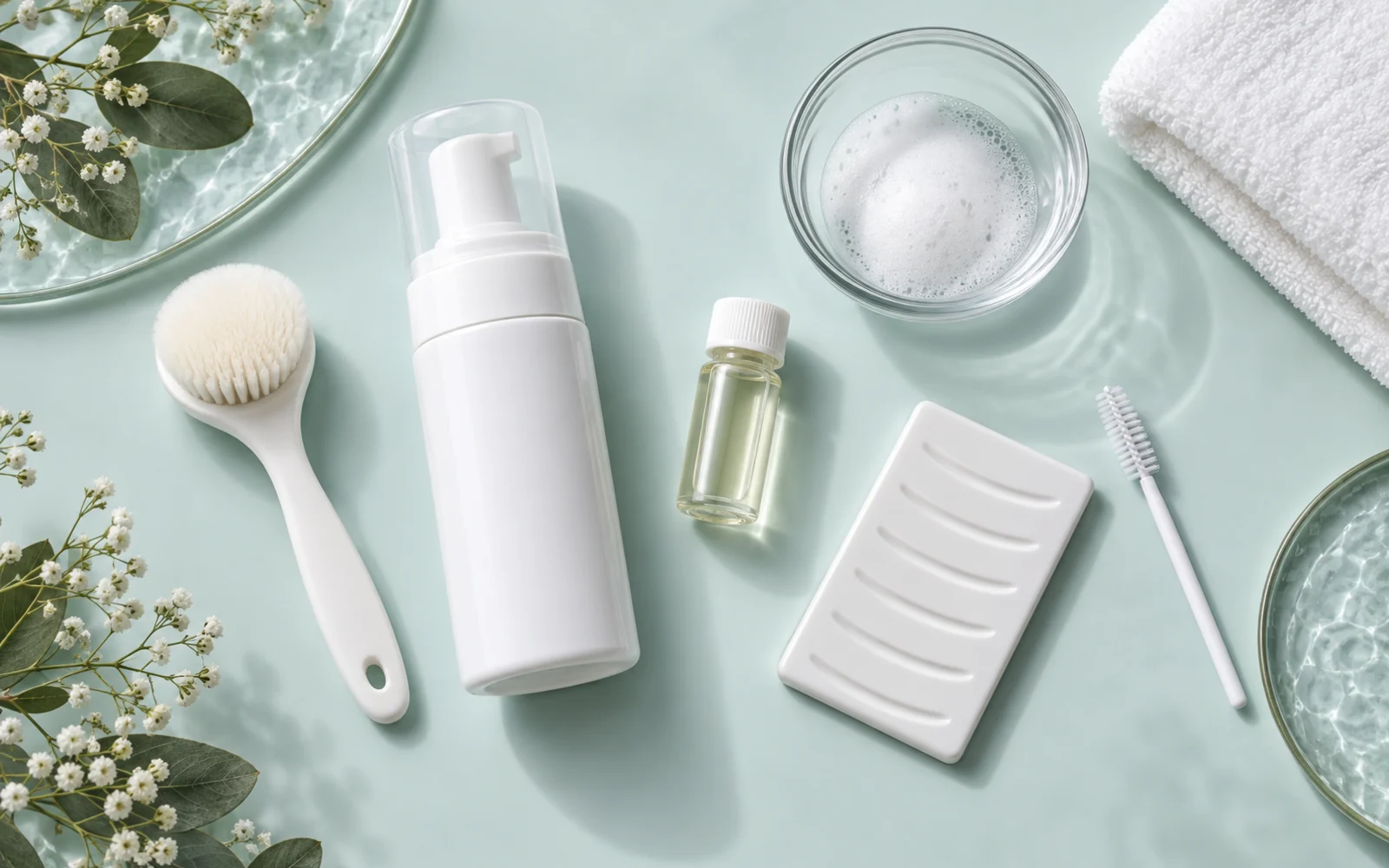
Lash shampoo may be a small item in a professional aftercare range, but it has an outsized effect on how consistently clients care for their extensions. A cleanser that does not remove sebum and makeup, is difficult to rinse, or leaves an incompatible residue can undermine the aftercare routine and make poor retention harder to diagnose. For a brand, distributor or salon buying wholesale, the real question is therefore not which scent looks best on a catalogue. It is which formula, dispensing system and instruction set work together for the intended user. This guide compares the main formats, shows how to build a focused fragrance range, explains the checks to complete before a bulk order, and maps packaging routes for salon use, resale and private label.
Why Lash Shampoo Decides Whether Clients Rebook
Retention strongly influences whether a lash client returns on schedule, but it depends on several linked variables: adhesive selection, room conditions, application, the client’s natural lash cycle and aftercare. Sebum, eye makeup, sunscreen and airborne soil can accumulate along the lash line. If clients do not remove that buildup under an approved routine, technicians lose both retention and a clear way to identify the real cause of a problem.
A lash cleanser has to do three things at once. It must remove the soil defined in the product brief. It must rinse according to the approved method without unwanted residue. And it must be suitable for its intended use so clients can follow the labelled routine. A product that misses any one of these requirements creates an aftercare problem, even if its fragrance and packaging test well.
That third failure mode is also the commercial one. A cleanser that feels uncomfortable or takes too many steps is unlikely to be used consistently, regardless of its formulation. For a wholesale programme, reorder timing should be calculated from the labelled dose, fill size and actual client usage rather than a promised universal consumption cycle. Lash shampoo also sits inside a system: primer, bonder and sealant affect preparation and finishing, while the cleanser supports the approved home-care routine.
Why Oil-Free Is a Starting Claim, Not the Finish
Cyanoacrylate adhesive cures through a moisture-initiated polymerisation process. After curing, retention can still be affected by contamination, mechanical stress and products that are incompatible with the adhesive system or its aftercare directions. This is why many professional ranges use an oil-free positioning, but it is not accurate to claim that every oil dissolves every fully cured adhesive. Adhesive choice and aftercare should be assessed together; our guide to choosing lash extension glue covers cure speed, humidity and technician workflow.
The problem is that “oil-free” on a label does not by itself prove residue performance, user comfort or compatibility with a particular adhesive. Two formulas can carry the same front-label claim while using different surfactants, fragrance systems and conditioning ingredients. The buyer therefore needs the full INCI list, the intended-use directions and compatibility evidence for the exact formula.
Treat the claim as a starting point and run three checks. First, request the full INCI list for the exact SKU rather than relying on the marketing description. Second, ask the formulator to identify ingredients relevant to rinsing, residue and the intended adhesive system; ingredient names alone do not establish performance. Third, compare the final samples under a documented cleansing-and-rinsing method. A glass dry-down check can reveal obvious residue, but it is only a screening step and does not replace compatibility, stability or user evaluation.
Fragrance is the second half of this decision. If a range needs a fragrance-free option, request a separately documented formula and verify the claim; a lightly scented product is not fragrance free. Any comfort or sensitive-skin claim also needs evidence for the final formula.
The Four Formats: Liquid, Foam, Cream and Concentrate
Format decides usage behaviour, freight cost and margin, so it deserves as much attention as the formula itself. The four formats below cover almost everything sold wholesale today, and each maps to a different kind of account.
| Format | How it dispenses | Best suited to | What to watch |
|---|---|---|---|
| Liquid | Pump or squeeze bottle | Salons wanting a familiar step-by-step routine | Easier to over-dispense; check the pump dose |
| Foam | Foaming pump | Sensitive clients and retail-facing brands | Foaming agents can leave film if poorly chosen |
| Cream | Squeeze tube | Heavier makeup removal, drier climates | Highest risk of occlusive residues |
| Concentrate | Bulk liquid or powder for dilution | High-volume studios, refill programmes | Requires dilution instructions and a clean mixing routine |
Liquid is familiar and easy to explain in a treatment room. Foam can simplify dose and distribution, but foam volume does not prove cleansing strength or mildness. Buyers should compare pump output, foam collapse, rinsing and residue rather than judging the product by a dramatic dispenser demonstration.
Concentrate can reduce freight and packaging per usable litre, but only when the supplier has designed and validated it for dilution. The trade-off is operational: dilution, water quality, container hygiene and in-use shelf life must all be specified. Never dilute a ready-to-use formula simply to lower cost. If concentrate is part of the range, supply a measured mixing container and instructions that match the approved formula.
Matching Fragrance Directions to Your Client Base
Fragrance is how a wholesale range gets merchandised, and it is also where most buyers over-buy. Ten or eleven directions look impressive on a price list; in practice, carrying all of them fragments your inventory, slows turns, and leaves you with dead stock in the two or three scents nobody reorders.
A more useful approach is to treat the range as four slots. The first is a neutral or separately substantiated fragrance-free option. The second and third are core directions selected from the buyer’s own sales data or a controlled launch test. The fourth is a seasonal or brand-led direction that gives the range a campaign story. This structure lets a buyer test demand without committing inventory to every available fragrance.
Only after those four slots are turning reliably should you widen the range — seasonal directions in summer, cosy or spiced directions in winter, and gift-oriented packs around the holidays. Ordering in a mix of bottle sizes and bulk sizes also helps: retail-sized bottles for salons that resell to clients, and larger bulk formats for studios that use the product in-house at volume, where a smaller pack simply becomes plastic waste. If you offer private label, nominate one core formula and one secondary direction for fast sampling so artwork and compatibility approval do not stall when a partner brand orders at short notice.
Map the Current Catalogue Before Choosing SKUs
Lashestar’s current catalogue covers ten filled fragrance directions plus an empty-bottle route. Buyers do not need to launch all eleven at once. Use the table to shortlist by channel, then confirm the current formula, fill size, accessories, MOQ and documentation in the quotation because those details can vary by SKU and destination market.
| Catalogue direction | Useful starting position | Buyer check |
|---|---|---|
| Apple | Bright retail direction | Confirm final product name and artwork |
| Banana | Playful retail or kit option | Review fragrance sample and label copy |
| Cantaloupe | Seasonal fruit direction | Confirm destination-market naming |
| Coconut | Soft fragrance direction | Do not infer a sensitive-eye claim from fragrance alone |
| Green tea | Professional-looking range | Confirm available bottle and bulk formats |
| Lychee | Distinctive retail direction | Test local customer recognition |
| Strawberry | Familiar fruit direction | Check colour and fragrance claim support |
| Passion fruit empty bottle | Self-fill or packaging programme | Validate compatibility with the buyer’s final formula |
| Rose | Floral brand direction | Compare against fruit variants in a small launch |
| Pineapple | Bright kit or retail direction | Confirm pack format and case configuration |
| Watermelon | Summer or youth-oriented direction | Verify the oil-free claim for the final formula |
What to Verify Before You Commit to a Formula
A wholesale order is hard to reverse once it ships and clears customs, so verification happens before the purchase order. The checks below help distinguish a controlled, documented supply programme from an offer built mainly around packaging and marketing claims. Request the relevant answers in writing for the exact formula and pack you are evaluating.
Ask for the certificate of analysis for the specific batch you will receive, and check that the batch code on the document matches the batch code on the carton. Request the full INCI list and confirm the order of ingredients, since the first five ingredients tell you more about the product than the front label. Ask for the pH range the formula is manufactured to — an aftercare cleanser intended for the lash line should be formulated and tested within a stated range rather than left to chance. Request the preservative system and the results of the microbiological challenge test, because a water-based cleanser that is inadequately preserved is a contamination risk once a client has opened it.
Then cover the practical and legal side. Confirm the stated shelf life both unopened and after first use, since those are rarely the same figure. Ask for the available safety documentation and the fill weight tolerance so you know what variation is normal. Establish whether the fragrance and any actives are subject to labelling or import restrictions in your destination market, and get that in writing before you commit to artwork. In the EU, for example, cosmetic claims must meet the common criteria in Commission Regulation (EU) No 655/2013. Finally, ask how the filler controls contamination on the line and whether mixing, filling and sealing occur at one site or through qualified partners. The important point is traceable responsibility and documented controls, not whether every operation happens under one roof.
Dispensing, Brushes and Instruction Cards
Two salons can buy the same cleanser and get completely different retention outcomes, purely because of how it is dispensed and taught. The product is only half the system; the routine around it is the other half.
Start with dose control. A pump that delivers a predictable amount reduces waste and makes it easy to instruct clients in a repeatable way, whereas a squeeze bottle encourages over-dispensing and runs out sooner. Whichever format you stock, dispense a single pump or a pea-sized amount into a clean palm, work it gently along the lash line with a soft brush, and rinse with lukewarm water. The instruction card should state the approved dose, brush method, rinse step and drying method. Avoid universal directions that have not been reviewed against the final formula and adhesive system.
Brushes and applicators matter more than they are given credit for. A dedicated soft cleansing brush reaches the lash line without dragging, and disposable lash wands let a client comb through after washing to separate any lashes that have stuck together while damp. Because these are the items clients lose, they are also the natural add-on to every shampoo reorder — which is why a shampoo range and a salon disposables line belong in the same conversation with a trade account.
The instruction card is part of the product system. A printed routine in the client’s language, optionally supported by a QR code to a short demonstration, makes the intended method easier to repeat. If you are shipping into a market where the language differs from your working artwork, prepare the required destination-language content during label review rather than leaving translation to the buyer after delivery.
Packaging, Kit and Private Label Routes
How you package a cleanser determines whether it is a product or a programme. The same litre of formula can be sold as a retail bottle, bundled into a professional kit, or supplied as an empty bottle for a brand that fills under its own label — and those three routes carry very different margins and expectations.
Retail bottles are the entry route: sensible volumes, clear labelling, and a size a client can hold in one hand. Kits are where average order value improves, because a starter set combining cleanser, a cleansing brush and a small applicator pack sells as a single decision instead of three — our lash tray and kit buying guide covers how to structure one. For salons, the kit is also an onboarding tool — it gives a new technician everything needed on day one, which is a far easier sale than assembling items individually.
Private label is the route that turns a wholesale buyer into a long-term partner. Empty bottles, caps and pumps supplied separately let a brand fill its own label without investing in moulds, and offering both the filled and the empty option means you can serve buyers at different stages of maturity. The practical detail that decides whether this works is minimum order quantity by size: a buyer who is told that every fragrance direction carries the same volume commitment will consolidate down to one or two SKUs, whereas tiered thresholds let them test. Hold one neutral and one popular direction in stock for fast relabelling, agree the artwork review step up front, and confirm the label spec before anyone commits to print.
Whatever route you choose, keep the range coherent. A buyer who already stocks your cleanser is the easiest person to sell a refill programme, a brush two-pack or a bulk format to — provided the formats and fragrances line up with what they already carry.
A Wholesale Buyer’s Checklist
Use the table below as a scoring sheet when you compare suppliers. Clear written answers make later sample approval and artwork review much easier. Missing evidence should trigger a follow-up or a smaller validation order rather than an assumption about how the supplier operates.
| Check | What good looks like | Red flag |
|---|---|---|
| Batch traceability | COA matches the carton batch code | “All batches are the same” |
| INCI transparency | Full list provided, order verifiable | Marketing description only |
| Oil-free claim | Exact formula reviewed, claim supported and compatibility checked | Front-label claim used as the only evidence |
| pH and preservation | Stated range plus challenge-test evidence | Numbers refused or vague |
| Shelf life | Separate unopened and in-use figures | A single figure for both |
| Fill tolerance | Declared tolerance per unit | No tolerance stated |
| Export compliance | Labelling and import requirements confirmed in writing | “No issues in your market” |
| Contamination control | Traceable mixing, filling and sealing controls | No documented responsibility for filling |
| Format options | Bottle, kit and empty-bottle routes all available | Single format, take it or leave it |
| Language support | Insert and label in the destination language | English-only inserts for non-English markets |
Two habits make this checklist pay off. Score every supplier against the same rows so you are comparing like with like, and re-run the residue test on arrival rather than trusting the pre-order sample — batch variation is real, and it is far cheaper to catch early than to explain to an account whose retention just dropped.
FAQ
Is lash shampoo the same as baby shampoo?
They should not be treated as automatically interchangeable. A baby shampoo is developed and labelled for a different use case, while a lash cleanser should have directions, packaging and supporting documentation appropriate to its intended eye-area routine. Compare the exact formulas and follow the extension system’s approved aftercare instructions rather than relying on the word “gentle.”
Can I make lash shampoo myself?
A home recipe is not an adequate basis for a professional or retail range. A commercial water-based cleanser needs a controlled specification, appropriate preservation, manufacturing records, packaging compatibility and the safety and labelling work required for its destination market. If a validated concentrate is available, follow the supplier’s exact dilution, water-quality, hygiene and in-use shelf-life directions; do not dilute a ready-to-use cleanser.
How often should clients use it?
Use the frequency stated in the final product directions and the lash professional’s aftercare protocol. The right routine depends on the formula, the client’s skin and makeup habits, and the extension system. The instruction card should explain when to cleanse, how much to use, how to rinse and when to stop using the product if irritation occurs.
Does oil-free mean tear-free?
No. The two claims address different product characteristics and require different support. An oil-free cleanser may still cause discomfort, and a fragrance-free product is not automatically non-irritating. The label should tell users to stop use if irritation occurs. The FDA’s eye cosmetic safety guidance also stresses clean applicators, contamination control and appropriate ingredient labelling for eye-area cosmetics.
Ready to build a focused cleansing range for salon use, resale or private label? Browse the Lashestar shampoo collection and request a quotation, including filled bottles, bulk-format options, kits and empty bottles subject to current availability.