
 View full-size diagram ↗
Lashes for hooded eyes should be planned around the part of the lid that covers the lash line, the natural lash direction and the client’s preferred outline. There is no single hooded-eye map and no curl letter that works for every person. A useful design remains visible where intended, allows comfortable clearance and can be supported by the natural lashes.
The key question is not simply “cat eye or doll eye?” First identify where the fold affects the visible set. Then compare the actual curl profiles and decide where the map should place emphasis. This guide separates those decisions and shows how to record them for a salon team or a product sourcing brief.
Hooded eyes describe lid coverage, not one eye outline
A hooded appearance occurs when a fold of skin partly covers the mobile eyelid in the normal open position. The amount and position of coverage can differ across the eye and between the two eyes. Someone can have a hooded lid and an almond, rounded or downturned outline at the same time.
Do not use hooded, monolid and double eyelid as interchangeable terms. A monolid has no visible eyelid crease; a hooded lid can have a crease partly concealed by the fold. For a lash consultation, these labels are less useful than recording what is actually visible and how the natural lashes emerge. The monolid and Asian lash extension guide discusses that distinction in more detail.
The purpose of the consultation is to understand the requested visual result, not to tell a client that their eye shape needs fixing. Some clients prefer a subtle outline that follows their existing shape. Others want more central definition or a sharper outer finish. The same lid observation can lead to different designs because the preferences differ.
Assess visibility with the eye normally open
A map drawn only from the closed-eye view can miss the way the lid fold changes the visible outline. During consultation, identify which areas are concealed and which remain exposed when the person is looking normally ahead. Do not rely on an exaggerated raised-brow expression or a photograph taken from above.
Record three observations separately: the area of coverage, the direction of the natural lashes and the intended area of emphasis. “Outer fold, outer lashes angled down, soft central emphasis requested” is more useful than simply writing “hooded.” It explains why an outer-heavy reference may need modification.
Where the two eyes differ, give each its own note. That does not require making them artificially identical. It provides a clear record of any deliberate difference in zone width, curl selection or peak location. The client should understand the expected visual effect before the record becomes a routine refill plan.
Compare a generic map with an assessment-led map
A generic map spreads its lengths without recording the lid observation. An assessment-led map begins with that observation and adapts only the variables that need changing. It may retain much of the original sequence. Customization does not mean using a special curl in every zone or increasing every length.
| Decision | Generic assumption | Better record |
|---|---|---|
| Peak position | Always extend the outer corner | Place emphasis according to the open-eye view and requested effect |
| Curl | Every hooded eye needs the strongest curl | Compare base shape, sweep and comfortable clearance |
| Length | Add length until everything is visible | Consider visibility together with natural lash suitability |
| Both eyes | Copy the same boxes | Record the lid coverage and any intentional adjustment separately |
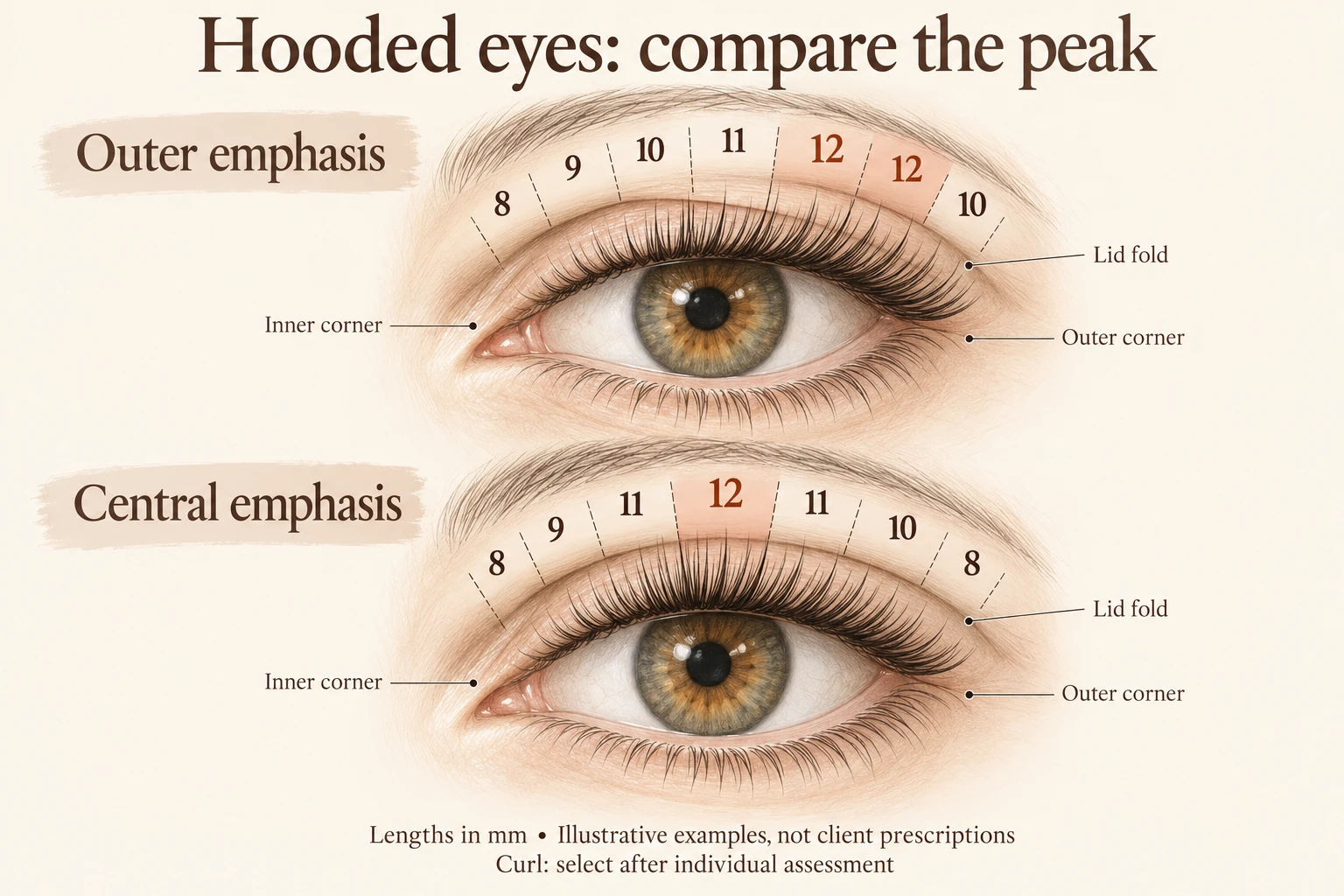
For a hypothetical seven-zone drawing, 8–9–10–11–12–12–10 represents an outer emphasis, while 8–9–11–12–11–10–8 moves emphasis centrally. These millimetre sequences are comparative illustrations, not hooded-eye recommendations. The useful difference is where the peak sits; the appropriate actual numbers require individual assessment.
C, CC, D, L or M: compare profiles rather than rankings
Curl letters are not a ladder on which a higher letter is automatically better for a hooded lid. Rounded curls and curls with a straighter base can position their tips differently. Their contact with the natural lash and their relationship to the lid must be evaluated together.
London Lash’s M curl guidance describes a straighter base followed by a pronounced sweep and emphasizes checking the client’s individual lid shape and natural lash direction. That supports considering M as an option, not prescribing it to everyone with a hooded lid.
| Profile to compare | What to inspect on the sample | What not to assume |
|---|---|---|
| Rounded C / CC / D families | How early the curve starts and where the tip sits | A stronger rounded curl always improves clearance |
| L / L+ families | Base length, transition angle and final sweep | Every supplier’s L curl is the same |
| M family | Straighter attachment section and the upward transition | It can compensate for an unsuitable load or attachment |
Our special curl reference explains how to compare supplier samples. If your preferred profile is not part of a confirmed product range, request a sample and availability review rather than substituting a similar letter on the assumption that it will behave identically.
Match the map to where the lid coverage occurs
If the coverage is mainly towards the outer side, simply putting the longest section at the end may fail to create the intended emphasis. A professional may consider moving the peak inward or using a different taper. If coverage affects the central area, the relevant question changes: how can the selected profile and silhouette remain visible without an unsuitable increase in length?
LashBase’s eye-type guide also distinguishes outer-only coverage from coverage across more of the lid. Its examples reinforce the need to locate the fold rather than select a map from the word hooded alone. Those are educational starting points, not measurements for your client.
A central or rounded outline may suit a request for openness; an outer sweep may suit a request for elongation. Either still requires review of the natural lashes and the final corner. The doll/open-eye map guide and fox-inspired guide show how those design intentions differ.
Length and density are not substitutes for clearance
When a portion of the set disappears under a fold, increasing length can look like an obvious solution. It may also create a heavier or less comfortable result. The design decision needs to account for the natural lash’s suitability, the selected construction and where the tip sits when the eye opens.
Likewise, adding density can make an outline darker without solving its direction. It can change the overall impression enough that the client perceives the eye as more enclosed. Discuss the desired amount of definition separately from the location of the peak, particularly when adapting a dramatic reference photo.
Write down what is being evaluated: visibility, contact, clearance or density. This prevents a chain of unrelated changes that makes the outcome difficult to interpret. If curl, length and fullness all change at once, it becomes harder to know which decision actually improved the requested result.
Review the final corner as its own section
The last visible section deserves its own decision even when the map has an outer emphasis. Fine, sparse or downward-directed natural lashes at the corner may call for a different finish from the adjacent peak. “Cat-inspired” describes an overall outline, not a requirement to maximize length on the last natural lash.
Record where the taper begins. An outer-heavy map with a short terminal section is easier to repeat when that detail is written down. A generic label such as “soft cat” can conceal a meaningful difference in the client’s approved design.
When comparing photographs, use the same gaze and a similar camera position. A set photographed with raised eyebrows can appear much more exposed than it does in normal expression. The consultation and review should be based on the appearance the client experiences throughout the day.
Use a short, specific consultation record
A useful record can be brief. Include the client’s reference, the requested effect, where the fold is visible, natural lash observations, chosen product profile, peak position and the reason for any right-left difference. Keep detailed health and consent information in the appropriate consultation system rather than on a supplier worksheet.
At review, add what changed or remained satisfactory. “Central emphasis liked; outer taper retained; review curl transition next visit” is more useful than a satisfaction score alone. It gives another trained team member a practical point of comparison without implying that the previous diagram should be copied regardless of the current lashes.
Use the blank mapping worksheet for the design record or the Lash Map Generator to prepare a digital reference. Neither tool detects lid clearance or evaluates lash suitability; those observations must come from the professional consultation.
What a salon should stock for varied hooded-eye requests
Do not build a “hooded-eye kit” around one long length and one dramatic curl. A more useful sample assortment offers the transitions needed by your actual clients and a small number of physical curl profiles that the team can compare consistently.
Start with the profiles and lengths used in approved services. Identify where the team regularly needs a shorter corner, a middle transition or an alternative curl. Track consumption before increasing stock depth. Mixed trays can help with initial comparison, while repeat use of particular lengths may justify single-length replenishment.
For a private-label brief, state the selected curl reference, construction, diameters, length assortment, row allocation, label and tray requirements. Explain that the range supports individualized styling; do not label it as suitable for every hooded eye. Browse the extension collection to select a starting product, then ask for confirmation of the exact combination.
Keep a useful review record
At the review, distinguish an appearance request from a product problem. Note whether the client wanted a more visible tip, less density or a different peak location. Attach the original product reference and map version to that observation. A clear record helps the next artist change one relevant variable instead of replacing every curl and length at once.
Questions about lashes for hooded eyes
What are the best lashes for hooded eyes?
There is no universal product or map. Compare the client’s lid coverage, natural lash direction and intended effect, then assess actual curl profiles and suitable construction. A product marketed for hooded eyes still needs that review.
Are L and M curls always better than D?
No. They have different profiles, and supplier naming varies. The useful comparison is how the base and sweep work with the natural lash and open lid. D is neither mandatory nor automatically unsuitable.
Should every hooded-eye map peak at the outer corner?
No. That may place emphasis exactly where the lid coverage or lash direction makes it least useful. Central, natural and modified outer directions can all be considered according to the consultation.
Will changing the map make extensions last longer?
A map records choices; it cannot guarantee retention. Application, products, natural shedding and aftercare also matter. Review the service process rather than attributing every loss to eye shape.
For the complete notation system and printable template, return to the Lash Map Guide. To discuss a sample range for your salon or brand, send your selected profiles, length assortment and packaging requirements through the inquiry form.