 View full-size diagram ↗
Asian lash extensions should be selected through an individual consultation, not an assumed ethnic template. Asian clients can have monolids, visible creases, hooded lids and many different eye outlines and natural lash directions. The useful questions are how the natural lashes grow, where the lid sits when the eye is open and what appearance the client wants.
This guide focuses on monolid and lid-coverage observations often raised in searches for Asian eyelash extensions. It explains why there is no universal D-curl minimum, no fixed extra-length rule and no single map that belongs to an ethnic group.
Separate ethnicity, crease and eye outline
Asian is a broad identity, not a lash specification. A monolid describes an eyelid without a visible crease. A hooded appearance describes coverage from a fold. Almond or round describes an outline. These terms refer to different features and should not be used as substitutes for one another.
In a consultation, describe the visible feature instead of assigning a whole set of assumptions. “Straight-growing natural lashes with partial central lid coverage” provides information for styling. “Asian eyes need D curl” skips the observations needed to justify the product choice.
The distinction also matters for packaging. A tray can be labeled with its actual curl, construction and lengths without implying that it is suitable for every client from a particular background. Clear specifications are more useful to a professional buyer than demographic promises.
Observe the natural lash direction independently
Natural lashes can point upward, outward or downward, and their direction may vary along the same eye. Record the pattern actually present. Do not infer length, strength or density from ethnicity or from the presence of a crease.
Evaluate the section where a proposed extension would sit, including the physical relationship between its base and the natural lash. The intended visual sweep and suitable attachment need to work together. A profile that looks dramatic on a tray is not automatically a practical match for every natural lash direction.
Where direction changes towards the outer corner, record that section separately. A single label for the whole eye can conceal a meaningful difference at the terminal lashes. The main mapping guide explains how to distinguish that observation from the chosen silhouette.
Why there is no universal D-curl minimum
A curl letter describes a product family, not a universal treatment threshold. Even within a familiar letter, the base, transition and tip direction can vary between manufacturers. Choosing a stronger-looking curl without reviewing those features can miss the actual reason a particular profile works.
BL Lashes’ educational discussion includes C, D, L and L+ among the profiles considered for monolid styling. That alone contradicts the idea that anything below D must be ineffective. Its product examples should still be assessed against the individual rather than turned into a blanket rule.
| Observation | Compare | Avoid assuming |
|---|---|---|
| Relatively straight natural lashes | Base contact and the position of the upward sweep | One curl letter is mandatory |
| Visible lid coverage | Where the tip sits with the eye normally open | More curvature always means more clearance |
| Different directions across the lash line | Whether a documented profile transition is appropriate | The whole eye must use one unchanging choice |
| Different supplier range | The actual sample against the approved reference | Matching letters guarantee matching profiles |
For a more detailed product comparison, use the curl guide and special curl guide. Confirm the exact profile and availability before building an assortment around it.
Assess lid coverage before changing the length
Some monolid or hooded clients have part of the lash line concealed in the normal open position; others have a different visible relationship. Identify where that happens before changing the map. An overall label cannot tell you whether the inner, central or outer area needs particular attention.
Do not automatically add a fixed number of millimetres to every zone. A longer extension changes more than visibility, and it still needs to be appropriate for the natural lash and selected construction. Review the physical profile, the intended outline and comfortable clearance together.
Use normal gaze and expression during consultation and visual review. Raising the eyebrows or altering the camera angle can make a set appear more exposed than it is in everyday use. Record the conditions under which the client approved the appearance.
Choose a silhouette from preference and observation
A client may prefer a balanced natural direction, central emphasis or an outer sweep. None of those preferences belongs to a single ethnicity. Start with the desired effect, then assess how the lid and natural lashes affect the proposed design.
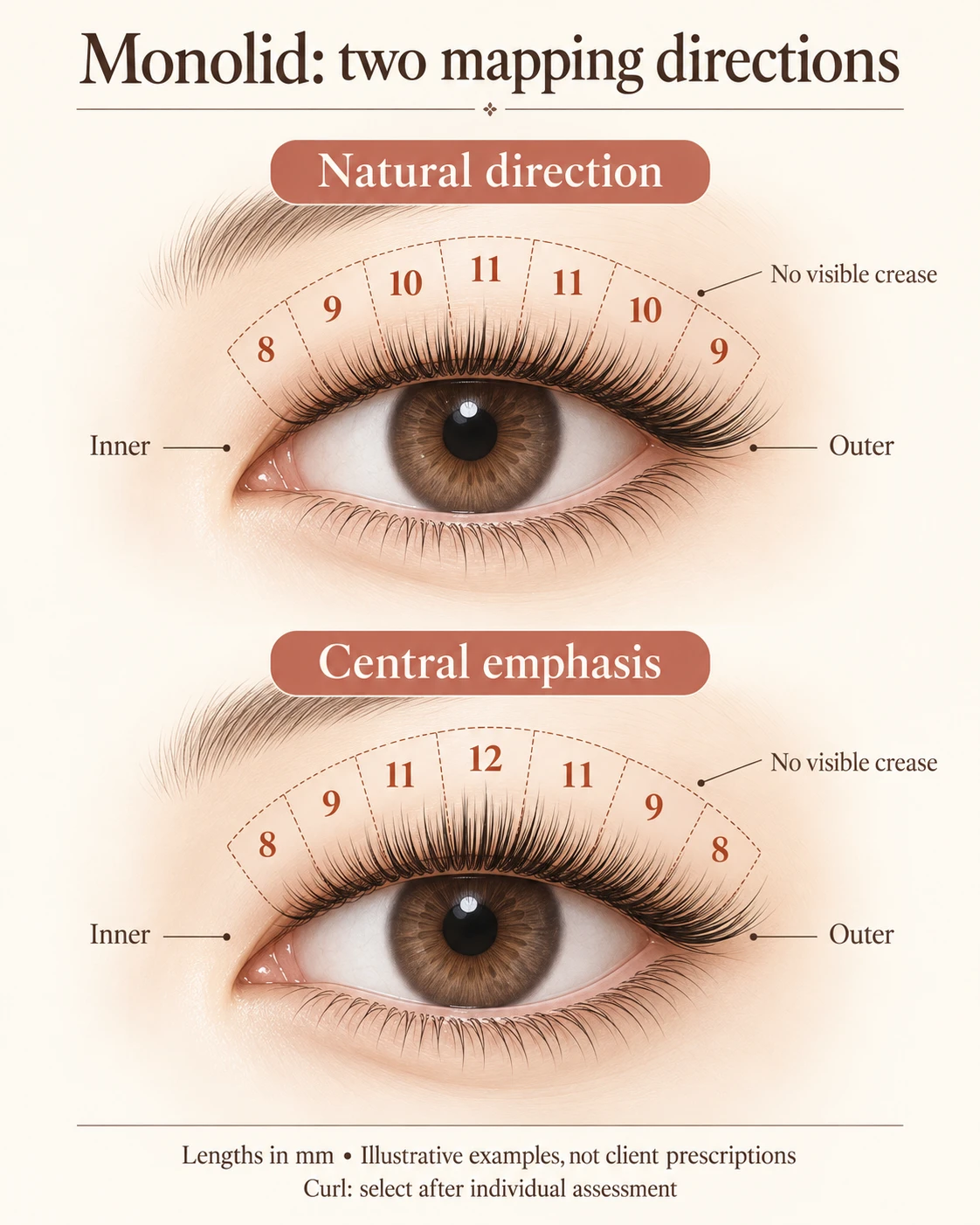
A hypothetical natural-direction map might use 8–9–10–11–11–10–9, while a central-emphasis example might use 8–9–11–12–11–9–8. These millimetre sequences are schematic comparisons only. They illustrate how emphasis moves, not recommended numbers for Asian or monolid clients.
If the request is an open-eye appearance, clarify what that means to the client. The doll and open-eye map guide explains central peak width and transitions. If the request is an elongated finish, the fox-eye guide explains why the final corner still requires its own decision.
Record both eyes and the full product specification
The two eyes may differ in their visible fold, lash direction or approved peak location. Keep separate right and left records where those differences matter. Identical numbers are not a substitute for an agreed visual intention.
Include the actual product line, curl, diameter, construction, length range and any layer or texture notes. When a map combines profiles, identify the transition rather than writing only a list of letters. A second artist should be able to understand the record without guessing which curl was placed where.
The blank worksheet includes space for these notes. Use a reference code when sharing a technical diagram outside the salon. A supplier generally needs the specification and approved sample reference, not a client’s identifying personal details.
Use product samples to resolve uncertainty
If two profiles appear promising, compare them as products before treating either as the standard option for a client group. Inspect the base, sweep, taper and consistency in the range you intend to use. Keep the comparison separate from claims about wear duration or universal comfort.
For a salon team, agree on the names used for approved references. “Our approved M sample” is more specific than “M curl” when several ranges are stocked. Store a labeled reference so a later reorder can be compared with the product originally selected.
For a private-label launch, a focused sample set can reveal which specifications deserve deeper development. Do not multiply lengths and curls simply to advertise a wide range. Every additional option creates another stock, labeling and approval decision.
Write an inclusive salon or brand description
Describe the service through its process: individual consultation, assessment of lash direction and lid relationship, and a map agreed with the client. This is more accurate than promising a single “Asian lash set.” It also gives clients a clearer idea of what to expect from the appointment.
Avoid statements that all Asian lashes are thin, short, weak or difficult to retain. Those assumptions can lead both the copy and the product choice away from the individual. Record what was observed rather than repeating a demographic generalization.
Similarly, avoid suggesting that a natural feature is defective. A client can request a different visual emphasis without needing their anatomy described as a problem. The consultation should focus on the desired appearance and appropriate product selection.
Prepare a purchasing brief without demographic shortcuts
A useful brief names the specifications the team has actually approved: selected profiles, lengths, construction, finish, row allocation and packaging. It can explain the styling needs the range supports, such as a choice of profiles for different natural lash directions, without claiming universal suitability.
Track consumption by specification rather than by an assumed ethnic category. This helps identify the real demand for particular transition lengths or profiles. Mixed trays may help at the evaluation stage; replenishment should follow actual use and the agreed delivery schedule.
Send a physical sample or clear profile reference where the curl shape is important. The specification-sheet guide covers this process. Browse the Lashestar extension collection and ask the team to confirm the requested combinations before finalizing packaging.
Questions about Asian and monolid lash extensions
Can Asian clients use C curl?
Ethnicity does not rule out a curl. The natural lash direction, physical profile, lid relationship and intended result determine what a trained professional considers appropriate. C is one of several profiles that may be evaluated.
Are monolids the same as hooded eyes?
No. A monolid has no visible crease, while a hooded appearance concerns coverage from a fold. The observations can overlap in a consultation, but the terms do not mean the same thing.
Should monolid clients always receive longer extensions?
No fixed increase applies to everyone. Review visibility, profile, natural lash suitability and the requested design together. A length number alone cannot establish an appropriate choice.
Is a doll map always best?
No. Central emphasis is one possible preference. The client may want a different outline, and the actual features still need assessment. Use the map to document a decision rather than select it from identity alone.
Continue with the hooded-eye guide for lid coverage or return to the complete Lash Map Guide for notation and the printable worksheet. For a sample review, use the manufacturing inquiry form.