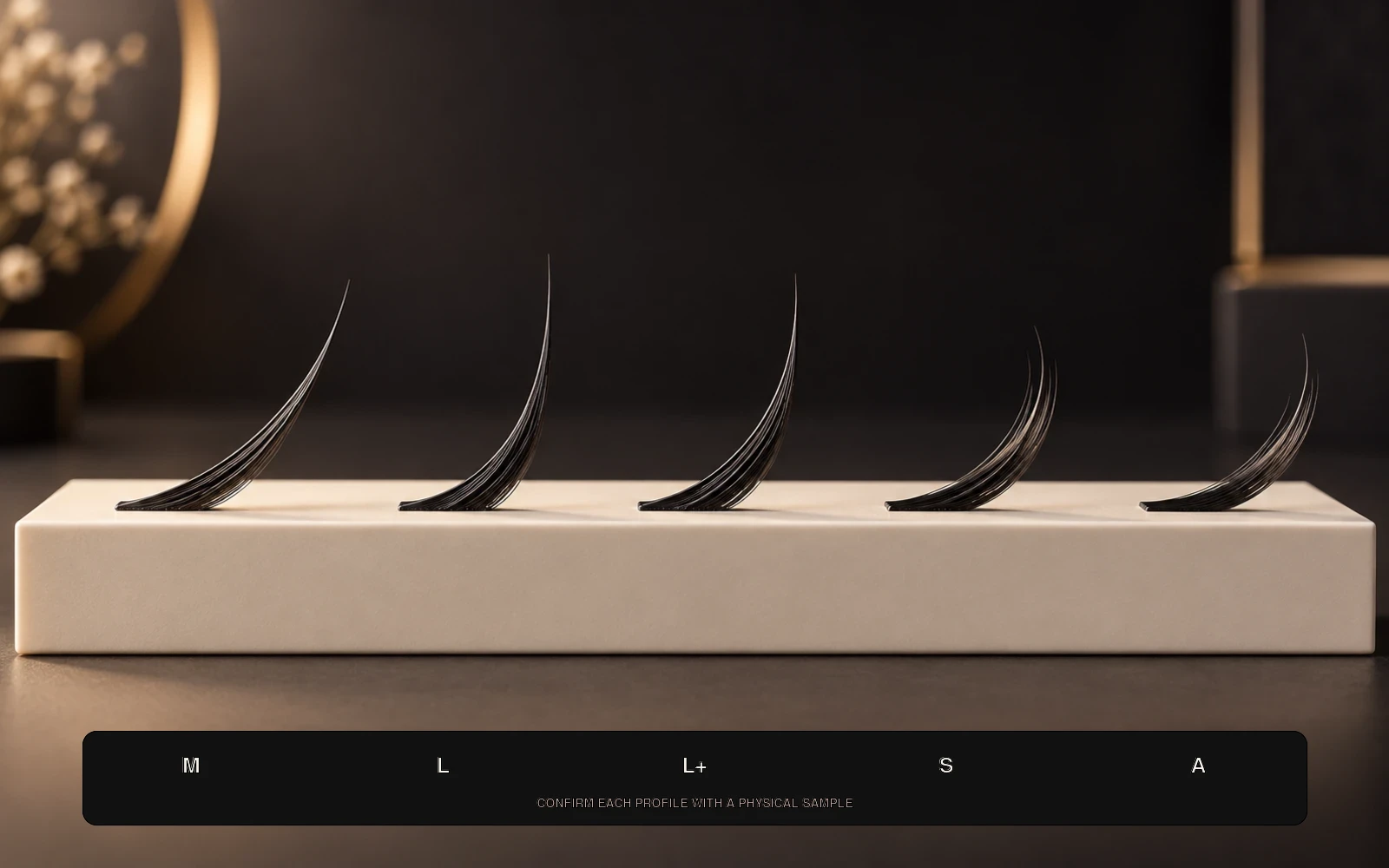
M, L, L+, S and A curls are often grouped as “special curls,” but they do not form one standardized family. Some use a flatter base with a defined lift, some change direction later in the fiber, and some names are used differently between manufacturers. That makes them valuable for differentiation and risky for purchasing if the brief contains only a letter. Review the standard lash curl profiles first so the special shape has a clear comparison point.
Lashestar’s current eyelash extension catalogue consistently lists J, B, C, CC, D, DD, L and L+ on relevant extension lines. M, S and A should be treated as development enquiries until the exact product, profile and sample availability are confirmed. This guide explains how to discuss those shapes without promising an unavailable specification.
What makes a curl “special”?
The difference is usually visible in the base and transition. Conventional curves rise progressively. L-family and M-style profiles may hold a flatter or more angular base before lifting, producing a stronger directional effect. Other labels, including S and A, can refer to different geometries depending on the supplier.
| Profile | Common purchasing description | What must be confirmed |
|---|---|---|
| M | Lifted profile with a defined transition and tapered direction | Base shape, bend position and current availability |
| L | Straighter base followed by a noticeable lift | Length of the flat base and final tip direction |
| L+ | L-family base with a stronger or rounder lift | Physical difference from the supplier’s L sample |
| S | A profile described with an S-like transition by some suppliers | Actual drawing, sample and intended construction |
| A | A softer or supplier-specific profile in some catalogues | Definition, mould reference and repeatability |
M curl lashes
M curl is commonly discussed when a stylist wants a directional lifted result rather than a continuous round curve. The profile can appear straighter near the base and more defined through the transition. However, there is no single global M geometry. Ask the factory for a side-profile photograph and a physical sample from the intended construction.
For a brand launch, explain what the M product should do visually, which customer segment it serves and how it should relate to the existing C, D or L products. The C curl vs D curl guide provides a useful baseline for that comparison. This commercial context helps the development team select the closest available route.
L curl vs L+ curl
L and L+ are useful because the straighter base section is visibly different from a continuously rounded curl. L+ normally communicates more lift than L within the same supplier’s range. The exact difference may come from the transition angle, radius or tip direction.
Do not approve the two profiles using top-down tray photographs. A side view is necessary to see the base length and bend. Compare loose fibers at equal length and diameter, then check how the profile presents when installed on the strip or built into a fan.
What about S and A curls?
S and A are not part of Lashestar’s consistently listed standard curl set. If a buyer requests one, the brief should include a reference profile, expected product construction, target length and diameter, and a description of the intended effect. Use the lash thickness and length guide when defining the size range. The factory can then confirm whether an existing mould or development route is available.
How to brief a non-standard curl
- State the requested name, such as M or S, but do not stop there.
- Attach a clear side-profile reference without relying on another brand’s label.
- Define classic, flat, easy fan, premade fan or another construction.
- Specify the required diameter and length range.
- Describe the base, transition and tip direction in words.
- Ask what is already available and what would require development.
- Approve and retain a coded physical sample before the bulk order.
Inventory strategy for a special-curl range
A special curl should solve a clear customer need. Launching every possible length and diameter at once can create slow-moving inventory. Many brands start with the product construction and sizes most relevant to their professional customers, gather feedback, and expand only after the profile has a repeatable use case.
Keep packaging architecture consistent with the core range while making the curl code easy to distinguish. The curl should appear on the tray label, inner card and outer box in the same format so warehouse staff and customers can identify it without opening every package. Plan those elements through the Private Label product and packaging process.
Before sampling, transfer the profile reference, construction, size range and packaging requirements into the lash specification template. The lash curl chart can be attached as a quick reference, but the approved physical sample remains the production standard.
Review the confirmed eyelash extension range or send a special-curl reference to Miya Chen for an availability and sampling review.