
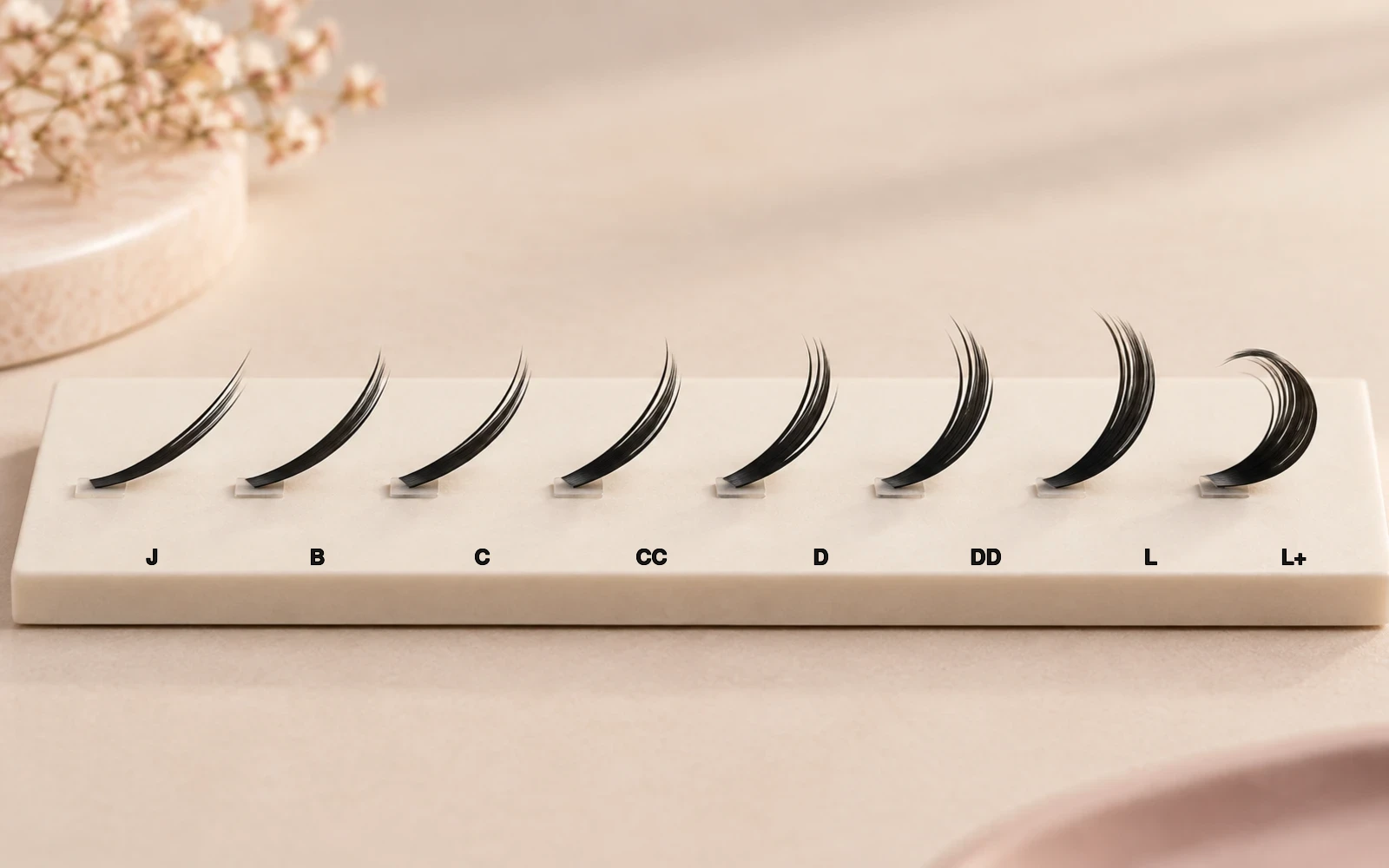
A lash curl name is a purchasing shorthand, not a universal measurement standard. One supplier’s C curl can look closer to another supplier’s CC curl because the base, transition and tip are formed with different tools. A reliable buyer therefore uses the curl name to start the conversation, then approves the actual tray that will be produced.
This guide explains the standard profiles currently listed across Lashestar’s eyelash extension range: J, B, C, CC, D, DD, L and L+. It also shows how curl interacts with length, diameter and the client’s natural lash direction. The goal is to help a lash brand write a clearer product brief rather than choose a curl from a letter alone.
What changes from one lash curl to another?
Look at three parts of the fiber: the base that sits against the natural lash, the transition where the fiber begins to rise, and the tip direction. A stronger curl does not simply mean a more curved tip. The position and radius of the bend also affect the visible lift and the usable attachment area.
| Curl | Relative profile | Typical visual direction | Buyer check |
|---|---|---|---|
| J | Very gentle rise | Subtle extension of a straight natural line | Check whether the result appears too flat for the target market. |
| B | Soft curve | Natural lift with restrained tip direction | Compare with J and C in the same length. |
| C | Balanced curve | Open, versatile appearance | Use as a reference profile when comparing stronger curls. |
| CC | Stronger than C | More visible lift without the strongest D profile | Ask for a physical comparison because CC naming varies. |
| D | Strong curve | Dramatic upward direction | Review the base and transition, not only the tip. |
| DD | Very strong curve | Maximum lift within the listed standard range | Check contact area and the intended styling use. |
| L | Flatter base, sharper lift | Defined direction after a straight base section | Confirm base length and bend position. |
| L+ | Flat base with stronger transition | More pronounced lift than L | Compare L and L+ side by side from the same batch. |
J and B curls: the softer profiles
J and B curls are useful when the desired collection needs a restrained visual direction. They can support natural looks and customers whose natural lashes already point in a compatible direction. Their lower visible lift also means that length and styling pattern become especially important: a long J curl and a shorter C curl do not create equivalent results.
For a wholesale range, ask whether both profiles serve distinct customer needs. If the market mainly buys visible lift, carrying both J and B may add inventory without adding a clear selling story. A sample board photographed from the front and side helps the sales team explain the difference.
C, CC, D and DD: compare the transition
C through DD form the central comparison set for many professional ranges. C is commonly used as a balanced reference; CC increases lift; D and DD move toward a stronger upward result. Our C curl vs D curl comparison examines that buying decision in more detail. Those descriptions are relative. They do not replace a sample because the transition can begin close to the base or farther along the fiber.
When reviewing samples, place the same length and diameter from each curl on a flat white card. Photograph them with the camera fixed at the same height. Compare the first few millimetres of the base, the highest point of the curve and the direction of the tip. This removes the visual error created by different tray angles.
L and L+: the base matters
L-family curls use a straighter base section followed by a more defined lift. That geometry can be useful when a range needs a distinctive lifted or directional result. The exact base length and bend shape are important production variables, so “L curl” alone is not a complete specification. Compare the profile with the other special lash curls before fixing the range.
Ask for L and L+ samples from the intended product line. A classic single fiber, a premade fan and a flat lash can present the same named curl differently because their construction and viewing angle differ.
How natural lash direction affects the choice
Eye shape is useful context, but the natural lash direction and condition are the more direct technical inputs. Downward, straight and upward-growing natural lashes change the way the extension sits and how much visible lift a curl produces. A professional lash artist must also decide whether the available attachment area is appropriate for the selected product.
Specify curl together with the other variables
Curl must be evaluated with the fiber diameter and length. Use the lash thickness and length guide to define those fields before requesting samples.
- Product construction: classic, volume, easy fan, premade fan, YY or another defined format.
- Diameter: the fiber diameter requested for that construction.
- Length: single length or mixed-length sequence.
- Curl: named profile plus an approved physical reference.
- Fiber and finish: color, sheen, softness and taper confirmed by sample.
- Tray layout: row count, strip arrangement and length labels.
- Branding: inner card, outer box, logo and required label information.
Lashestar product records list J, B, C, CC, D, DD, L and L+ across relevant eyelash extension lines. Available combinations depend on the product, so the team confirms the exact construction after receiving the brief. The lash specification sheet guide shows how to record the combination without leaving production decisions ambiguous.
How to approve a curl sample
- Compare samples from the same supplier and product line.
- Use the same diameter and length for every curl in the comparison.
- Inspect from the side, front and above under consistent light.
- Check the base, transition and tip direction separately.
- Record the approved sample code, product construction and date.
- Keep an approval sample for comparison with the bulk order.
For a branded collection, connect the approved fiber and curl to the tray label, inner card and outer box. The Private Label process explains how product and packaging approvals fit into one project.
Ready to define a range? Review the current eyelash extension collection, then send Miya Chen your product, curl, diameter, length, quantity and packaging requirement.