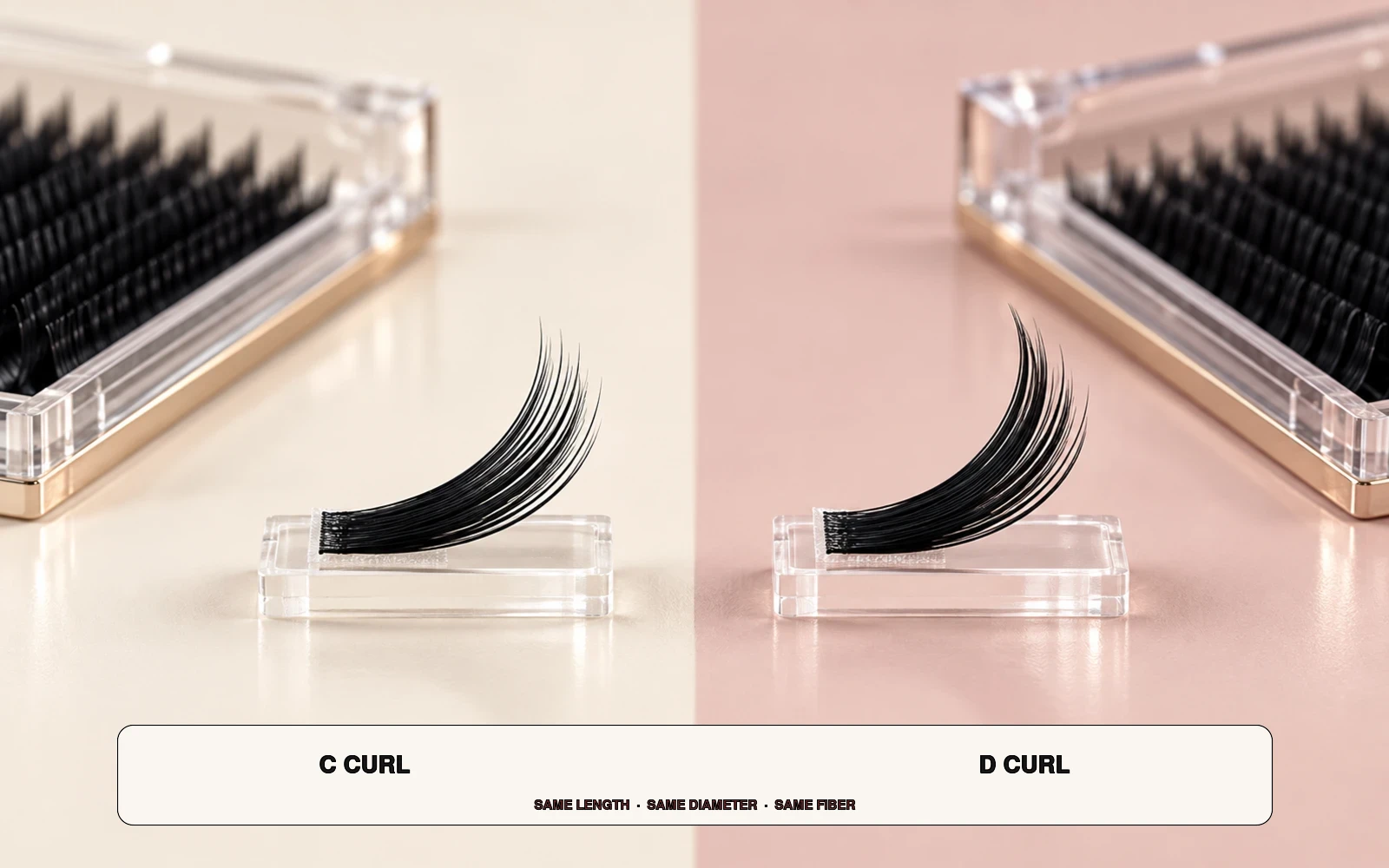
C curl and D curl are often presented as a simple choice between “natural” and “dramatic.” That is useful for a sales conversation, but it is not enough for a product brief. The real difference lies in the full profile: how long the base remains relatively straight, where the transition begins and how strongly the tip rises. Start with the complete lash curl guide if the wider J-to-L+ family also needs to be compared.
For a lash brand, the safest answer is practical: C curl is usually the more balanced reference profile, while D curl produces stronger visible lift. The final choice must still account for the natural lash direction, the desired styling result and the actual sample supplied by the factory.
C curl vs D curl at a glance
| Decision | C curl | D curl |
|---|---|---|
| Relative lift | Balanced | Stronger |
| Visual direction | Open and versatile | More upward and dramatic |
| Comparison role | Useful reference profile | Useful stronger-lift option |
| Buyer risk | Can look flatter than expected if the supplier profile is soft | Can reduce usable contact if chosen without checking the base |
| Approval requirement | Physical samples in the same length, diameter, fiber and construction | |
Is D curl curlier than C curl?
Within the same supplier’s system, D is normally the stronger curl. Across different suppliers, the labels are not precise enough to guarantee an identical curve. A strong C from one mould can approach a softer CC or D from another. This is why changing factories without re-sampling can create a visible change even when the packaging still says the same curl.
Ask the supplier to place C and D of the same specification on one comparison card. Do not compare a 9 mm C curl with a 14 mm D curl; length changes the apparent arc and makes the decision unreliable. The thickness and length guide explains how those dimensions affect a wholesale assortment.
Which curl suits downward-growing natural lashes?
Downward-growing lashes often create demand for more visible lift, which can make D attractive. But stronger visible lift is only one part of the decision. The lash artist must still assess how the extension base aligns with the natural lash and whether the contact area is suitable for the service being performed.
A B2B product page should avoid promising that D curl “fixes” a particular eye shape or lash direction. A more accurate product message is that D provides a stronger upward profile than C and should be selected by a trained professional after assessing the natural lashes.
Is C or D better for hooded eyes?
There is no single curl that is best for every hooded eye. Lid space, natural lash direction, chosen length and mapping all change the visible result. A shorter D section may create lift without pushing the tips too close to the lid; a C profile may provide a softer open effect; a mixed map can use different curls by zone.
For brand education, explain the choice as a set of variables rather than a diagnosis based on the eye-shape label. This is also more useful to professional buyers, who need products that can support several mapping decisions.
When a mixed C and D map makes sense
C and D can be used in one styling plan when the artist wants controlled variation in lift. A common principle is to keep transitions gradual: introduce the stronger curl in a defined zone rather than switching abruptly between adjacent sections. The exact map depends on the design, natural lashes and lengths selected.
For a brand range, mixed-curl education works best when C and D are manufactured in matching fiber color, finish, strip behavior and packaging. If the two curls come from different specifications, the set may look inconsistent even when the map is technically correct. Record those shared requirements in a production-ready lash specification sheet.
C, CC and D: when the middle option helps
CC can bridge the visual gap between C and D. It may be useful for brands that want a graduated curl family or for artists who find C too restrained and D too strong for a particular design. Since CC is also supplier-dependent, compare all three on one sample board. For flatter-base and directional alternatives, review the special curl guide.
Five checks before approving C or D
- Same construction: compare classic with classic or premade with premade.
- Same diameter: a heavier-looking fiber can change the perceived curve.
- Same length: use one length for the technical comparison.
- Same viewing angle: photograph the tray and loose fibers consistently.
- Same approval standard: record the selected sample and keep it for bulk inspection.
Use the printable lash curl chart during the first comparison, then confirm the selected profile as part of the Private Label development process.
Compare the available products in the eyelash extension range. For a private-label project, send the team the curl, length, diameter, construction, quantity and packaging brief.