
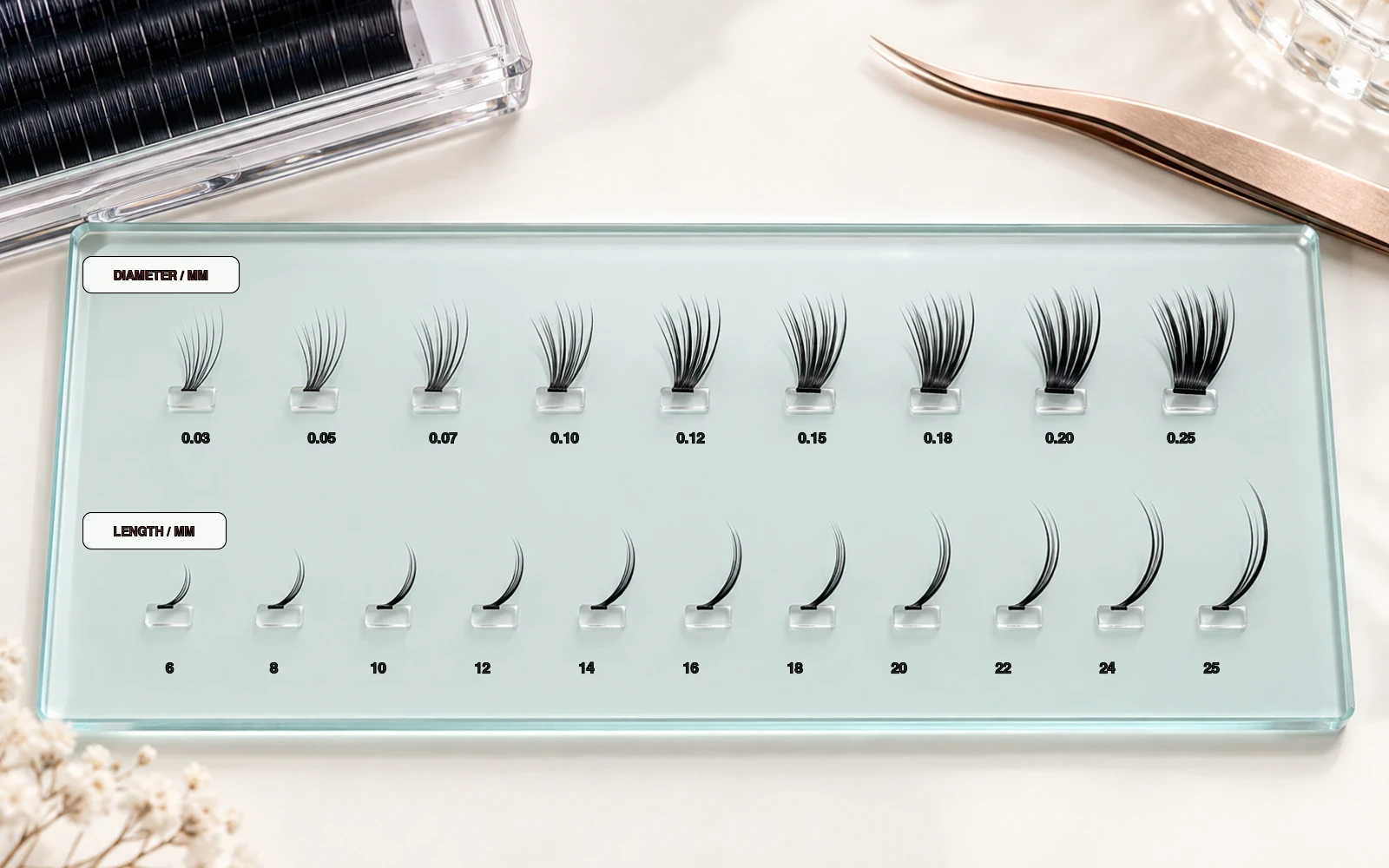
Eyelash extension thickness and length are not two separate catalogue filters. Together they determine the visual weight, product construction, tray assortment and way a professional customer will use the product. A 0.07 mm fiber in a volume fan serves a different purpose from a 0.15 mm classic fiber, even when both are supplied in the same length and curl.
Lashestar’s relevant product records list diameters from 0.03 to 0.25 mm and lengths from 6 to 25 mm. That does not mean every diameter, length and construction can be combined. The exact range must be confirmed against the selected product in the eyelash extension catalogue.
What eyelash thickness means
Thickness usually refers to the nominal diameter of an individual extension fiber. As the number rises, the fiber generally looks and feels more substantial. But diameter alone does not fully describe perceived weight: taper, cross-section, fiber material, finish and fan construction all matter.
| Diameter group | Typical purchasing context | Questions for the sample |
|---|---|---|
| 0.03–0.05 mm | Fine fibers commonly considered for volume-oriented constructions | Does the fiber separate cleanly? Is the color consistent? How does the finished fan behave? |
| 0.07 mm | Widely used fine diameter across volume, easy fan and premade products | Does the strip support the intended pickup method and fan construction? |
| 0.10–0.12 mm | Mid-range options for selected classic or specialty applications | Does the apparent thickness match the target market’s expectation? |
| 0.15 mm | Common reference diameter for classic-style ranges | Check softness, taper, finish and consistency through the tray. |
| 0.18–0.25 mm | More substantial-looking fibers for specifically defined ranges | Confirm professional use case and product availability before ranging. |
This table is a buying framework, not an application rule. A trained lash professional is responsible for assessing the client’s natural lashes and selecting a safe, suitable service.
How length changes the result
Length is measured in millimetres, but the visible result also changes with curl. A strongly curved fiber may project differently from a softer curl of the same labelled length. Compare the shapes in the lash curl guide before fixing a length range. The placement in a mapping design matters as well: shorter inner lengths, a controlled peak and a taper toward the outer zone can create a very different result from one length used across the whole eye.
For wholesale planning, decide whether the product will be sold as single-length trays, mixed trays or both. Single-length trays support professionals who use large quantities of specific sizes. Mixed trays can simplify trial, education and starter inventory, but the length sequence and row allocation must match how customers actually work. The curl and size chart provides a compact format for reviewing the combination.
Match product construction to the diameter range
| Product construction | Briefing priority | Do not assume |
|---|---|---|
| Classic | Individual fiber finish, taper, curl and strip pickup | That every listed diameter is equally popular or suitable for the market |
| Volume | Fine-fiber consistency and behavior during fan creation | That diameter alone determines the finished fan |
| Easy fan | Layering, base behavior and pickup from the strip | That the same specification behaves like a standard volume strip |
| Premade fan | Fan dimension, base, symmetry, bonding and count | That “3D” or “6D” fully describes the product |
| YY or specialty | Construction shape, split, curl, length and visual density | That the same diameter looks identical across constructions |
Build a mixed-length tray deliberately
A mixed tray needs more than a minimum and maximum length. State the exact row sequence. For example, a 16-row tray could allocate more rows to the highest-use middle lengths and fewer rows to the extremes. The correct allocation depends on the customer’s service mix, so validate it with working professionals or historical sales.
Also define how each strip is labelled, whether the tray card shows the full specification and whether the outer carton repeats the curl and length mix. Clear labelling reduces picking errors for both warehouse teams and lash artists. These details should also appear in the lash specification sheet.
A practical sample comparison
- Select one construction and one curl.
- Compare adjacent diameters at the same length.
- Compare several lengths at the same diameter.
- Inspect color, sheen, softness, taper and strip release.
- Ask working professionals to test the relevant pickup behavior.
- Record the approved sequence for single or mixed trays.
If the collection includes L, L+ or another directional shape, review the special curl buying guide before applying the same length allocation used for a rounded curl.
Example buyer brief
Product: volume lash tray
Diameter: 0.07 mm
Curl: C
Lengths: 9–13 mm mixed
Rows: state the required row count and exact allocation
Fiber/finish: confirm against the approved sample
Packaging: define inner card, tray label and outer box
Quantity: provide the forecast so MOQ and production timing can be confirmed
When the size block is approved, connect it to the box, inner card and label through the Private Label development route.
Use the current eyelash extension catalogue to select a starting product, then send the full combination for sampling and quotation.