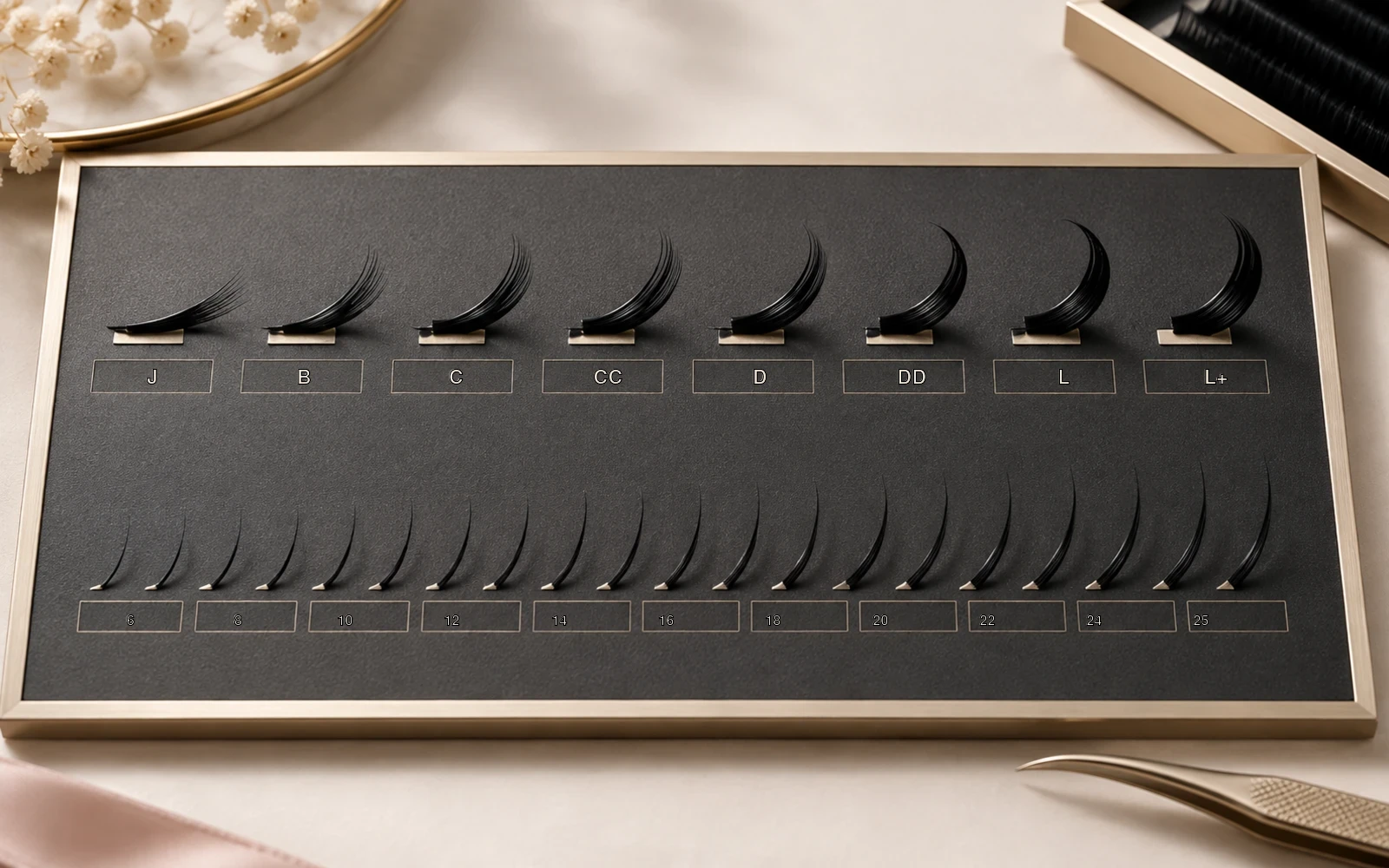
This lash curl chart condenses the main buying decisions in the Lash Curl & Specification series. Use it to prepare a brief, compare samples and check a tray label. Do not use it as a universal mould standard: curl letters can differ between manufacturers.
Download the printable A4 Lash Curl and Size Chart (PDF)
Lash curl chart
| Curl | Relative lift | Profile cue | What to check |
|---|---|---|---|
| J | Very soft | Gentle rise | Whether the finished look is too flat for the target customer |
| B | Soft | Natural curve | Visible difference from J and C |
| C | Balanced | Versatile rounded profile | Use as the reference sample |
| CC | Strong | More lift than C | Supplier-specific transition |
| D | Stronger | Pronounced upward direction | Base, contact area and tip direction |
| DD | Very strong | Maximum lift in the listed standard family | Exact use case and physical profile |
| L | Directional | Flatter base followed by lift | Base length and bend position |
| L+ | Stronger directional | Flat base with greater lift | Difference from the supplier’s L sample |
For photographs, profile terminology and a fuller approval method, continue to the complete lash curl guide. Buyers deciding between the two most common stronger profiles can use the focused C curl vs D curl comparison.
Diameter reference
| Nominal diameter | Common catalogue context | Approval focus |
|---|---|---|
| 0.03 / 0.05 / 0.07 mm | Fine-fiber and volume-oriented ranges | Consistency, pickup and fan construction |
| 0.10 / 0.12 mm | Mid-range classic or specialty options | Taper, finish and target-market demand |
| 0.15 mm | Common classic reference | Softness, blackness and strip behavior |
| 0.18 / 0.20 / 0.25 mm | More substantial-looking selected ranges | Confirmed product availability and professional use case |
Lashestar’s relevant catalogue records show a 0.03–0.25 mm range, but availability depends on construction and SKU. A diameter list is not a recommendation for use on a particular client. Read the lash thickness and length guide before turning these numbers into a product assortment.
Length reference
Relevant products in the eyelash extension catalogue list 6–25 mm. Define whether the tray is single length or mixed length, then write the exact row allocation. Compare lengths at the same curl because stronger curls can change visible projection. L-family and other directional shapes need the additional checks described in the special curl guide.
| Tray type | Specification format |
|---|---|
| Single length | Product + diameter + curl + one length + row count |
| Mixed length | Product + diameter + curl + every included length + rows assigned to each length |
| Mixed curl | Separate allocation for every curl and length; confirm whether it is one SKU or several |
The one-line specification formula
Construction + fiber/finish reference + diameter + curl + length sequence + row count + tray/strip details + packaging + quantity + approval sample.
Use the full eyelash extension specification template when this one-line formula needs to become a factory brief.
Example: Volume lash tray · approved matte-black fiber sample · 0.07 mm · C curl · 9–13 mm mixed · 16 rows · row allocation to approve · branded inner card and outer box · quantity by SKU to confirm.
Product approval, branded inner cards and outer packaging can be planned together through Lashestar’s Private Label service.
Quick approval checklist
- Same supplier, fiber, diameter and length used for curl comparison.
- Product construction named precisely.
- Single or mixed length arrangement recorded.
- Strip, inner card and row count defined.
- Logo, label copy and outer packaging approved separately.
- Quantity split by SKU.
- MOQ and production schedule confirmed after the complete brief.
Continue with the full lash curl guide, browse the current extension range, or ask Miya Chen to review a purchasing specification.