
 View full-size diagram ↗
Fox eye lashes describe an elongated, directional look with emphasis towards the outer part of the eye. The term overlaps with cat eye and eyeliner-effect styling, and its exact meaning varies between artists and brands. A useful fox-eye brief therefore shows where the peak sits, how the outer section tapers and which physical curl profile creates the intended direction.
There is no single required length sequence or curl for fox eyelashes. This guide explains how to distinguish the requested effect from a product nickname, compare fox and cat-eye drawings, assess the terminal corner and prepare a clear sample or stock brief.
Define the requested fox-eye effect
Ask what the client likes in the reference: the horizontal extension of the outline, the upward sweep, a dark lash line, a narrow flick or the textured finish. Those features are related but not interchangeable. A set can be elongated without being very dense, and an upward curl does not by itself produce a sharp outer silhouette.
Use two or three reference images to identify the shared feature. Makeup, a winged liner and the angle of a photograph can make a reference appear sharper than the lash set alone. A clear consultation separates those influences from the part that extensions are expected to create.
The finished style should be described in ordinary terms as well as with its nickname. “Soft outline, outer emphasis and a short final taper” tells the artist and buyer more than “fox set.” Record the desired density separately, especially where a client wants the direction of a dramatic image with a lighter everyday finish.
Fox eye versus cat eye: where the terms overlap
Both terms commonly describe an outward emphasis. Some educators use fox for a sharper or more directional variation, while others distinguish it through the selected curl and the apparent wing. There is no universal technical boundary that all suppliers apply.
LashBase’s mapping examples describe fox and cat styles through outward progression and elongation. This is useful vocabulary, but the precise design still needs a drawing. Two sets sold under different names may use similar length distributions.
| Variable | Soft cat-inspired brief | Sharper fox-inspired brief |
|---|---|---|
| Intended impression | Gradual outer sweep | More defined outer direction |
| Peak | Specified outer area, with a documented taper | Specified area creating the chosen flick, not automatically the last lash |
| Curl | Physical profile chosen for the client | Physical profile chosen for direction and appropriate contact |
| Density | Recorded separately | Recorded separately; sharp does not mean maximum volume |
Use the styles and types guide for the distinction between silhouette, application method and texture. A fox-inspired map can be discussed alongside classic or volume components, but the product and application choices must be appropriate to the client’s natural lashes.
Read a fox-eye diagram from inner to outer
Label each end before recording the lengths. The important questions are where the rise starts, how broad the peak is and how the last section finishes. If the record only lists the maximum length, it does not show how the eye reaches that point.
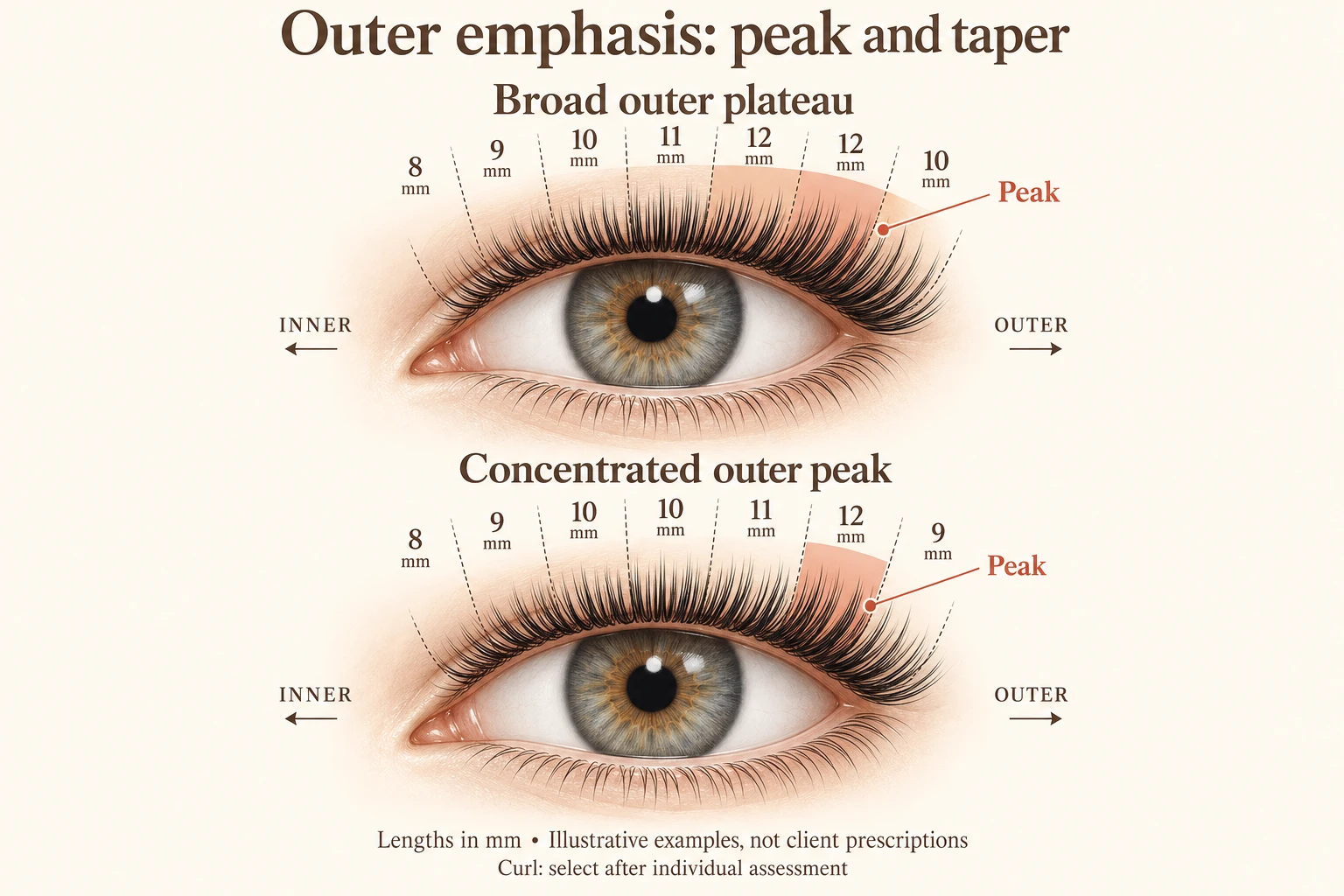
Two hypothetical seven-zone sequences illustrate the difference between a broad sweep and a narrower outer emphasis. In millimetres, 8–9–10–11–12–12–10 creates a broader outer plateau; 8–9–10–10–11–12–9 creates a more concentrated peak with a clearer terminal drop. These are original drawing examples, not approved client maps or a definition of cat versus fox.
A professional may select a different range entirely. The sequence should be judged together with zone width, curl and construction. A narrow 12 mm section and a broad 12 mm section will not occupy the same visual area. Changing the maximum number without reviewing the boundaries can miss the source of the desired effect.
Do not make the final corner longest by default
Outer emphasis is a design direction. The last natural lashes still need individual assessment. Where the final corner has a downward direction, limited density or unsuitable support for the proposed component, a long terminal section can work against the intended outline.
Moving the peak slightly inward and recording a shorter final section is one possible modification to discuss. It preserves an outward intention without assuming the terminal lashes must create the entire wing. The correct change depends on the actual consultation, not on a rule that every fox set must end in the same way.
Describe the taper with its start point and intended visible finish. A note such as “outer peak before the terminal section” is more reproducible than “lift the corner.” During review, check the set in normal gaze rather than judging only a close-up image taken from above.
Choose curl for shape and contact
L and M families are often mentioned in discussions of directional lash styling. Their base and sweep can create a different appearance from rounded curls, but their names do not make them mandatory for a fox-inspired result. Compare samples from the actual product line.
London Lash’s M curl article explains its profile and its use in selected styling areas. It also separates curl choice from retention claims. The relevant purchasing question is which profile has been reviewed and approved, rather than whether the label says “fox curl.”
When a map combines profiles, record the transition. A sudden change in apparent height can be mistaken for a length problem. Compare the physical fibers and the intended direction before adjusting millimetres. Our curl guide provides a consistent vocabulary for those notes.
Who might prefer an outer-emphasis style?
A client who wants a more elongated outline may be interested in a fox-inspired direction. That preference is more informative than assuming every person with a particular eye-shape label wants the same effect. An almond outline can support a range of visual intentions, including central emphasis or a balanced natural direction.
Assess lid coverage, the outer lash direction and the client’s preferred amount of definition. For some hooded eyes, the relationship between the curl and the lid is a more important first decision than the style name. For a downward-directed corner, the location of the peak and taper deserve particular attention.
The hooded-eye guide and almond-eye mapping guide cover these observations separately. There is no need to force a client into a style category if their requested appearance is better described by a modified or mixed direction.
Separate a sharp outline from a heavy set
Density changes how dark and continuous the lash line appears. It is not the same variable as the position of the longest section. A clear outer direction can be discussed with different levels of fullness, and more volume does not automatically make the silhouette more precise.
For textured work, identify the base and any accents separately. An outer spike can create a point of attention that is not represented by the base map alone. If a reference includes spikes, record whether they are essential to the requested result or simply an optional texture detail.
Product construction must remain part of the specification. A classic extension, a narrow volume fan and a textured cluster are not interchangeable simply because they share a nominal length. For professional volume purchasing, the premade fan guide explains the additional fan and pack details that need confirmation.
Use a controlled comparison when refining the design
If the approved prototype looks too round, first review whether the issue is the peak location, curl direction or overall density. Do not automatically add length to the outer section. A written comparison makes the revision purposeful instead of turning it into a sequence of unrelated adjustments.
For example, keep the selected range and construction constant while discussing a revised peak width. On a separate review, compare curl profiles if that remains necessary. The professional assessment determines what changes are appropriate for the individual; the worksheet simply keeps the reasoning visible.
Record the result in plain language: “outer sweep approved; terminal taper retained; lower density requested.” This helps the next appointment or the next sample order begin from a clear decision. Keep the previous version labeled so it cannot accidentally be used as the final instruction.
Build a fox-inspired salon assortment
A practical stock plan covers the short inner and terminal lengths, the intermediate transitions and the selected outer peak. Buying only long trays because a style is described as elongated leaves the team without the components that make the progression work.
Begin with measured use across approved services. If a small group of transition lengths is repeatedly consumed, those may deserve deeper replenishment than the longest option. A mixed tray can support sampling, while single-length trays can support repeat demand. The right allocation follows usage and lead time, not an assumed ratio of map boxes.
Separate new curl profiles from the regular assortment until samples have been assessed. Training, pickup behavior, strip characteristics and labeling can all influence whether a range is practical for the team. A familiar letter from another supplier does not remove the need for that comparison.
What to include in a private-label fox-eye brief
| Brief item | Useful detail |
|---|---|
| Style reference | A labeled diagram showing peak, taper and desired outline |
| Product | Construction, diameter, selected physical curl and finish |
| Assortment | Lengths and row allocation based on expected use |
| Packaging | Tray layout, label, inner card, carton and artwork requirements |
| Approval | Named sample or reference, revision date and agreed acceptance points |
If the brief uses L or M terminology, ask the supplier to confirm availability and the exact profile rather than assuming every combination is stocked. Lashestar’s extension collection is a starting point for a specification inquiry, not a guarantee that every curl, diameter and length combination is available.
Label the version you actually tested
Give each trial map a short version name and date. A label such as outer-peak trial A is easier to trace than several photographs all called fox eye. Keep the curl samples and zone notes with that version, then record the client’s feedback in their own words. This separates a preference for a sharper silhouette from a request for greater overall length.
Questions about fox eye lashes
Are fox eye lashes the same as cat eye lashes?
The terms overlap. Fox often implies a sharper directional effect, but there is no universal boundary. Show the intended peak, taper and curl profile instead of relying on the name alone.
Do fox eyelashes need L curl?
No single curl is mandatory. L and M profiles may be considered for some directional designs, but the natural lashes, lid relationship and desired appearance determine the appropriate choice.
Should the longest extensions be on the very last lashes?
Not automatically. The final section needs its own assessment. An outer peak can sit before a shorter terminal section while retaining an elongated overall direction.
Can a fox-eye map guarantee a lifting effect?
No. A diagram cannot guarantee the same visual result on different eyes. The final appearance depends on the chosen products, placement, natural features and the client’s expression.
Use the main Lash Map Guide to record the design or prepare a digital reference in the map generator. For wholesale samples, send the complete product and packaging brief through the manufacturing inquiry form.