
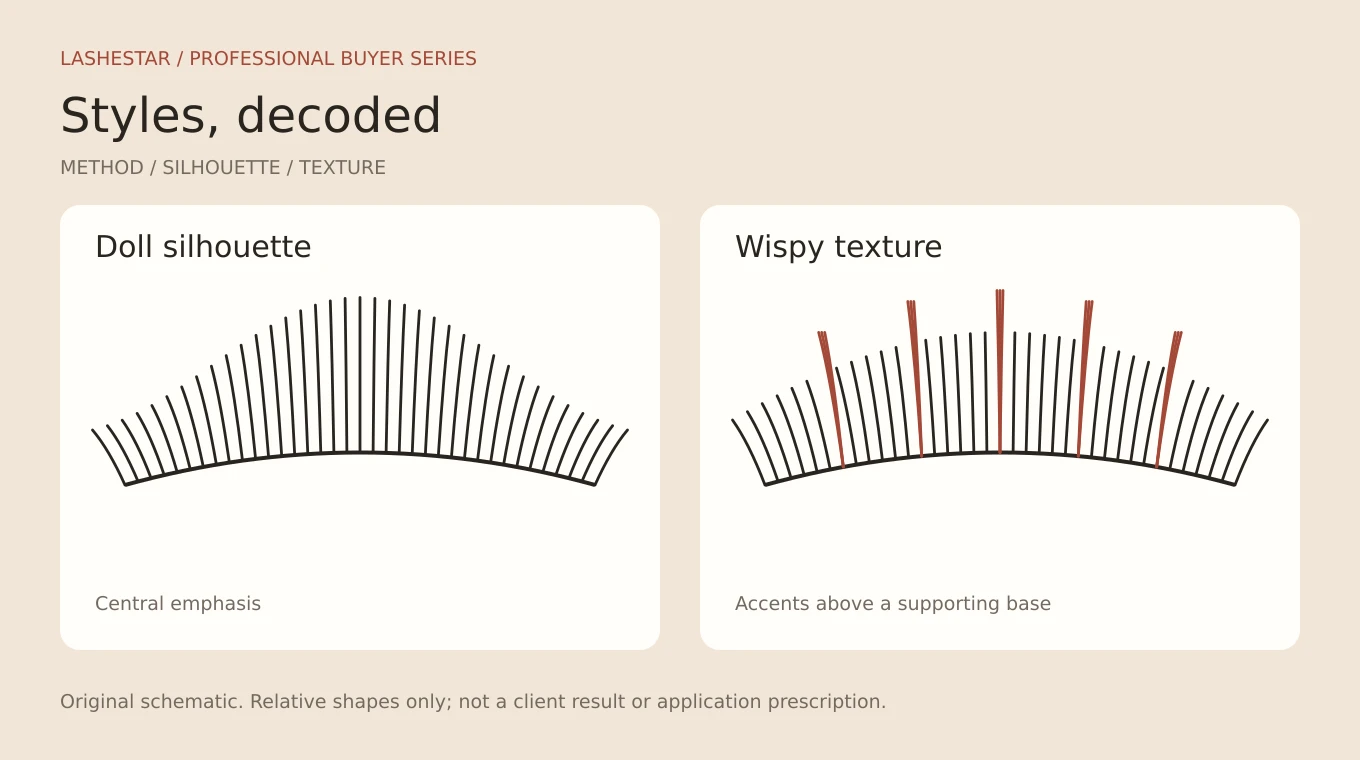
Lash extension styles describe the finished look; lash extension types often describe how that look is built. A client can ask for wispy doll-eye hybrid lashes without contradicting herself: wispy describes texture, doll eye describes the length distribution, and hybrid describes the application method. Understanding those three decisions makes a consultation clearer and a wholesale product brief much more useful.
This guide separates the names used by salons, explains the differences buyers actually need to specify, and connects each style to a practical stocking decision. Start with the comparison table, then use the dedicated guides for texture, mapping and fan selection. There is no single industry list of officially defined styles, and a fashionable name is never a complete specification.
Why eyelash extension names get confusing
Different lash styles are often presented as if they were competing products on one shelf. In practice, the names answer different questions. Classic and volume answer how extensions are arranged on suitable natural lashes. Cat eye and doll eye answer where the visual emphasis sits. Wispy and wet look answer how separated, fluffy or pointed the finished texture appears.
Material and product format introduce another layer. A synthetic fiber, a flat extension, an easy-fanning strip and a premade fan are product descriptions. None automatically determines the overall style. A premade fan can support a rounded map or an elongated map; a classic set can look restrained or emphatic depending on the chosen specifications and natural lash distribution.
For a brand manager, this distinction prevents duplicate ranges with different names but identical contents. For a salon, it prevents ordering a tray called “doll lashes” and expecting the tray to create the map. The artist still chooses placement, length progression and density. The purchasing brief needs the physical product details underneath the marketing name.
Lash extension styles and types: the comparison table
The eye-shape notes below are consultation directions, not automatic rules. The natural lash line, growth direction, lid relationship and requested finish matter as much as an eye-shape label. Diameter examples belong in a sample discussion; they are not a prescription for every natural lash.
| Name | What it describes | Visible feature and consultation cue | Product brief |
|---|---|---|---|
| Classic | Application method | Individual definition; useful when the client wants a cleaner outline | Single extensions; confirm diameter, profile, curl and lengths |
| Hybrid | Method combination | Single-extension definition mixed with fan texture | Classic and volume components; document their distribution |
| Russian volume | Volume technique / service name | Fans build fullness; traditionally associated with an even finish | Fine fibers or approved fans; specify count, base and width |
| Mega volume | High-density volume approach | A denser visual result, subject to individual assessment | Fine-diameter systems and a documented fan design |
| Natural | Overall effect | Subtle enhancement that follows the existing outline | Lengths and curls chosen to preserve the intended restraint |
| Doll / open eye | Map | Central emphasis; discuss how much roundness is wanted | Short ends and a defined central peak zone |
| Cat eye | Map | Outer emphasis; assess the direction of the outer lashes | A graduated length range with a controlled outer finish |
| Kitten / squirrel | Map family | Peak before the outermost corner, followed by a taper | Lengths supporting both the rise and the final drop |
| Wispy | Texture | An intentionally uneven upper outline | Base lengths and accent lengths recorded separately |
| Wet look | Texture | Defined narrow or closed bundles rather than a fluffy spread | Consistent fine-fiber bundles and controlled base geometry |
| Anime / manga | Graphic styling family | Distinct points with visible separation between accents | Clearly specified spikes, filler and optional lower-lash plan |
| Angel | Light textured effect | Delicate definition and an airy, uneven finish | Light components; assess texture before adding curl variation |
| Eyeliner effect | Visual effect | Emphasis close to the lash line with a directional outer shape | Shorter supporting lengths and a deliberate curl transition |
Names such as fox, Kim K or dramatic volume may mean different things in different salons. Add a reference photograph and describe the visible feature instead of assuming the label travels unchanged between markets. A customer asking for different kinds of lashes may also mean strip lashes or clusters; establish the intended application format before discussing a professional extension service.
First decision: classic, hybrid or volume?
Classic extensions
Classic application uses one extension on an individually isolated suitable natural lash. That makes the individual extension profile especially visible. The finished density still depends on the natural lash distribution, so a product name cannot promise the same fullness on every person.
For sourcing, compare consistency along the strip, tip finish, curl profile and pickup behavior. A flat profile and a round profile with the same printed diameter should not be treated as physically identical. Specify the cross-section when it matters to the sample approval. Keep the deeper parameter discussion in the curl and specification series.
Hybrid extensions
Hybrid combines classic extensions and volume fans. London Lash’s hybrid styling explanation distinguishes that method from wispy texture and describes different possible proportions. A hybrid set does not have to be a fixed half-and-half split, and the name alone does not tell a buyer which trays will be consumed fastest.
A useful salon record describes where the components go. “More single-extension definition through the central area, softer fans between accents” communicates more than a percentage without placement. For a brand, sell the components with clear names and let a tested service brief explain their combination.
Russian volume and mega volume
Volume uses several finer extensions arranged as a fan for one suitable natural lash. Russian volume commonly refers to that technique and its fuller finish. Mega volume generally moves toward greater fiber counts and finer individual diameters, but there is no universal numerical boundary that makes every supplier’s service labels equivalent.
Compare the exact diameter, length, fan count, base and spread. A large printed D number does not independently prove that a fan is light, suitable or well made. The Russian lashes guide explains these distinctions without treating a marketing category as a loading rule.
Second decision: where should the emphasis sit?
Doll eye: central emphasis
Doll styling puts the strongest length emphasis around the central region and shortens toward the ends. The purpose is a more open, rounded impression. “Central” needs to be judged on the actual open eye rather than copied mechanically from equally spaced marks on a pad.
A consultation should establish whether the client wants more roundness or already feels that her eyes look very round. Compare a narrow central peak with a broader central plateau before deciding. Our doll lash guide includes an illustrative map and explains what a buyer needs in the length assortment.
Cat eye: outer emphasis
Cat-eye styling moves emphasis toward the outside. An outer focus can be created through several combinations of length, curl and direction; it does not mean making every final corner lash as long as possible. If the outer growth direction already slopes downward, the artist must consider how a longer extension will read when the eye opens.
In a supply brief, include both the main graduated lengths and the short corner sizes. A tray selection that includes only the dramatic middle and long sizes can leave artists without the transition pieces that make the silhouette coherent.
Kitten and squirrel: an earlier peak
These labels often describe an outer-oriented shape that reaches its peak before the final corner and then becomes shorter. Salons may distinguish the two names more precisely, so ask for a map rather than treating them as guaranteed synonyms. The practical purchasing question is whether the assortment supports an intentional taper.
For a multi-location salon, record the peak zone in relation to visible landmarks, then let the trained artist adapt it to the individual. A common vocabulary helps staff discuss the result without forcing everyone into one unchanging drawing.
Third decision: smooth, fluffy or pointed texture?
Wispy and wet look
Wispy describes a broken or uneven top line. Wet look describes the more defined appearance of narrow or closed bundles. The two can coexist, but they are not identical requirements. A style can have distinct accents above a soft fan base, or use repeated narrow bundles with relatively little fluffy spread. See the wispy and wet-look comparison before preparing a joint stock list.
When comparing references, look at the spaces between peaks as well as the peaks themselves. If the filler rises too close to the accent tips, the intended contrast may disappear. That is a design relationship, not a reason to add longer fibers without reassessing the whole map.
Anime and manga
Anime-inspired extensions use conspicuous points and deliberate spacing to create a graphic impression. London Lash’s mapping guide describes manga styling with longer accents among shorter sections and discusses optional lower lashes. There is no requirement that every anime set use the same number of peaks or the same outermost length.
The anime lash guide separates the reference style, extension format and map. This is especially useful for brands because the same search term can refer to professional extensions, strip lashes or consumer cluster products.
Angel
Angel is a softer textured direction rather than a technical curl category. London Lash’s Angel guide emphasizes light, wispy definition using narrow components. Mixed curls can be part of an artist’s version, but they do not define the style. Our Angel lashes article explains how to write a sample brief around the visible result.
How to select a style without promising a universal fit
Start with the customer’s preferred visual effect: discreet definition, central opening, outer elongation, soft texture or prominent points. Ask which feature in the reference matters most. A person may like the separation in an anime photograph but not its length, or the softness in a wispy set but not its outer emphasis.
Next, assess the natural lashes and the way the eyes look open. A single eye-shape label cannot describe asymmetry, growth direction, density and lid interaction. The consultation belongs with a trained artist, and a downloadable map is a planning aid rather than an automatic treatment recommendation.
Then choose the method and translate the design into components. Keep base lengths, accent lengths, curl and fan construction separate in the record. If the first sample misses the target, change one variable at a time so the team can explain why the next sample is better.
Finally, approve the result in ordinary viewing conditions. A tightly cropped photograph with dramatic lighting may hide the outline seen at conversational distance. For internal comparison, use consistent light, camera distance and angle, and obtain permission before using client photographs in marketing.
Turn the selected styles into a stock plan
A salon offering six named styles does not necessarily need six unrelated tray families. Several services can share the same base lengths and fine-fiber system. Organize the range around the components that genuinely differ: single extensions, hand-fanning fibers, finished fans, narrow accents and any separately approved specialist components.
Build the first order from a pilot service mix. Record which curl and length combinations are actually used, including short transition sizes. Mixed trays can help evaluation; single-length replenishment can suit established usage. Neither format is automatically better, and a visually attractive mixed tray can still contain rows a salon rarely uses.
Row count is a packaging dimension. A 12-row tray does not create a 12D fan; a 6D fan does not imply six rows in a tray. For premade fans, compare the number of usable fans, their layout and pickup behavior. The premade fan buying guide includes a pack-planning worksheet and examples from the Lashestar catalogue.
As an illustrative inventory exercise, imagine a salon consumes four times as many medium base lengths as its longest accent length. Ordering equal quantities of every size would tie up stock in slow-moving accents while the core size runs out. Use recorded consumption to set the ratio, then review it after the launch rather than converting a sample map directly into a bulk order.
What to include in a supplier brief
- Intended result: reference image, style name and a plain-language description.
- Application format: professional individual extensions, finished fans or another explicitly identified product.
- Fiber details: material, nominal diameter, profile, finish and approved curl reference.
- Map components: base and accent length ranges, fan counts, spread and stem requirements.
- Pack configuration: rows or usable fan count, mixed-length allocation, label fields and refill format.
- Approval process: sample identifiers, tester feedback, accepted differences and production checks.
Keep the signed sample and its specification together. If a supplier changes the curl tooling, fiber profile or fan base, a matching marketing name is not sufficient evidence of an equivalent product. Decide which changes require a new approval before production begins.
Questions about lash extension styles
How many types of lash extensions are there?
There is no single count because lists mix application methods, maps, textures and product formats. The useful starting methods are classic, hybrid and volume, followed by the silhouette and texture choices. A longer list of fashionable names is not necessarily a better consultation tool.
Are wispy lashes always hybrid?
No. Wispy describes texture. A hybrid method can produce a wispy result, but texture and method should be recorded separately. This distinction helps the artist choose components and helps a buyer avoid ordering an unnecessary classic component for every textured range.
Does a stronger curl create a more dramatic style automatically?
No. The result depends on the combination of length, curl, placement, density and the natural lash direction. Compare actual supplier samples; letter names are not a universal geometry standard. Keep curl selection linked to the intended open-eye result.
Can one premade fan range support several styles?
It can support different maps when its construction suits the intended service. However, a wide fluffy fan and a narrow defined accent do different jobs. Approve each function rather than assuming a finished fan can perform every role.
Where should a wholesale buyer start?
Define the service audience and two or three priority looks, then prepare a component list and a sample evaluation. Browse the lash extension collection for product families and send the style brief for a wholesale or private-label discussion. Availability and final specifications should be confirmed against the approved sample.
Keep the service menu and stock catalogue connected
A useful internal system has two linked records. The service record describes the client-facing result and the artist’s map. The stock record describes the exact component being ordered. A service can reference several stock codes, and one stock code can support several services.
For example, a salon might use the same medium base lengths in a soft wispy service and in a centrally emphasized volume service. Those services do not require duplicate inventory names for the shared component. The differing accents or map notes belong in the service record, while the common physical item keeps one replenishment code.
Review the connection after a pilot. If staff repeatedly substitute a size because the intended item is unavailable, record that rather than silently changing the reference. The feedback may justify a new pack allocation, a different replenishment quantity or a clearer service description. A small range that can be reordered accurately is more useful than a long list of style names with no dependable component plan.