
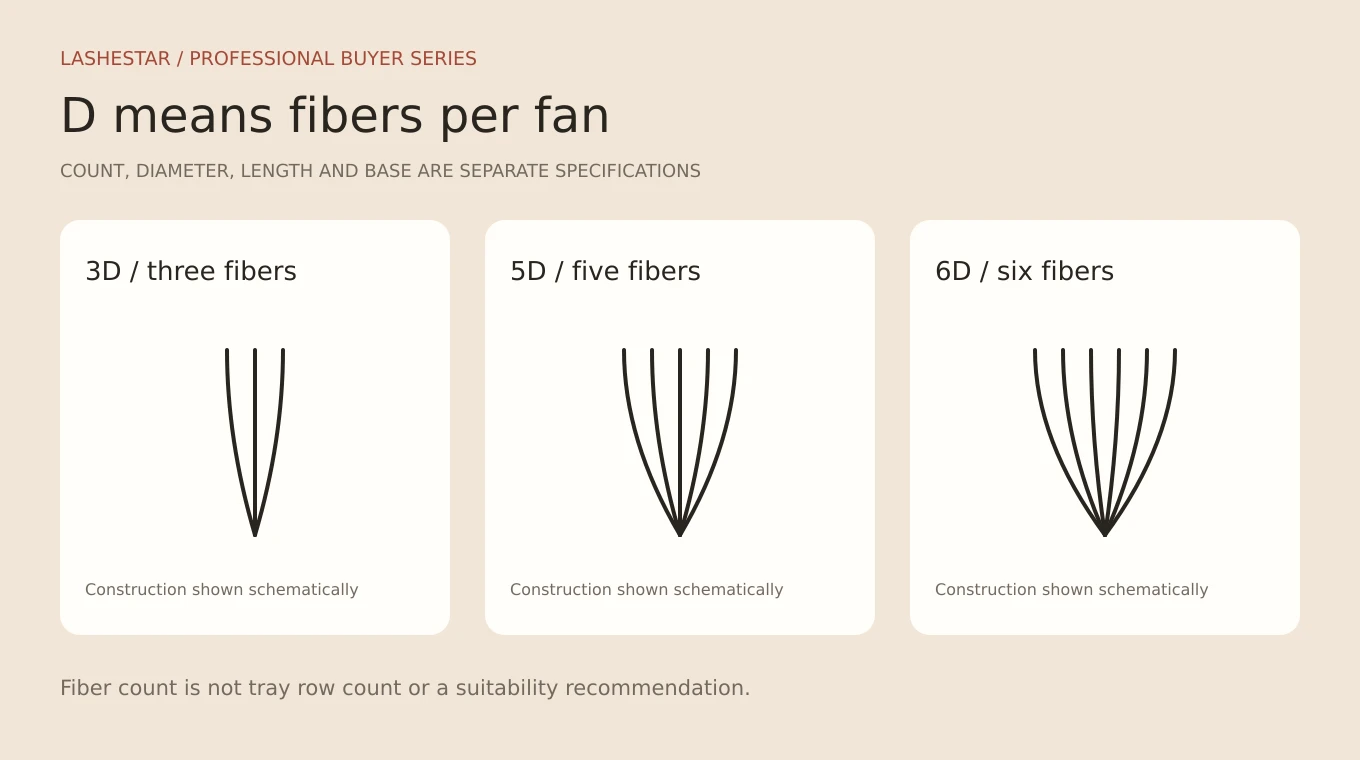
Premade eyelash fans are extension fans formed before the professional service. A 3D fan contains three fibers, a 5D fan contains five, and a 6D fan contains six. Those numbers do not identify the curl, the tray row count or the total number of usable fans in the pack.
For wholesale buyers, the real comparison is the complete component and pack: fiber count, nominal diameter, length, curl, spread, stem, construction and usable quantity. This guide explains how to compare those fields, evaluate samples and build a replenishment plan without treating the D number as a universal quality or suitability score.
What 3D, 5D and 6D actually mean
| Marking | Meaning | Still needs confirmation |
|---|---|---|
| 3D | Three fibers in one fan | Diameter, length, curl, spread, stem and pack count |
| 5D | Five fibers in one fan | The same fields; count alone does not describe the base |
| 6D | Six fibers in one fan | The same fields; it does not mean six rows per tray |
| D curl | A supplier’s curl label | The actual approved curl profile |
| 12 rows | A pack layout description | How many usable fans each row contains |
A buyer can therefore request a 6D fan in a particular curl packed in a 12-row tray. These are separate attributes. Write them in separate fields on the specification sheet so a sales conversation cannot accidentally swap one for another.
A higher count does not independently establish complete fan mass, professional suitability or workmanship. The practitioner must assess the complete component for its intended use. For the distinction between service categories, read the Russian and mega-volume guide.
Premade, promade and easy-fanning are not interchangeable
Premade describes fans supplied already formed. Promade is often used by suppliers to emphasize hand-prepared fans, but usage varies. Easy-fanning describes a different product approach intended to assist fan creation; it should not be assumed to mean the pack already contains individual finished fans.
Ask the supplier to show the actual contents and explain the construction. Is the pack a strip of individual fibers, a strip of separated finished fans or a loose-fan format? How is the base formed, and what does the professional user pick up? Those questions matter more than whether the marketing copy uses “pre made” or “promade.”
Keep the intended application format clear. Professional extension fans should not be confused with consumer cluster lashes simply because both contain more than one fiber. Their intended systems and instructions need to be identified separately.
Compare fan spread as well as count
A narrow and a wider fan with the same count distribute the fibers differently. Ask for an agreed reference view and compare several pieces rather than the best single example. If the range is intended to support a soft base, the desired spread may differ from a component intended for sharper definition.
Record the width or an agreed visual tolerance in the sample brief. If a dimension is supplied, confirm where and how it is measured. A numerical specification without a measurement method can still lead to disagreement.
When the brief involves wispy or wet-look styling, separate the supporting fan from any accent component. An open fan is not automatically a narrow spike, and a good product can be the wrong shape for the intended role.
Stem and base construction deserve a close look
Long-stem and short-stem names describe different base proportions, but they do not tell the whole story. Inspect the bond area, alignment and consistency across the pack. Ask the supplier to explain its construction rather than inferring it from a distant tray image.
Evaluate pickup in the intended professional workflow. Note whether components release cleanly, distort, split or remain stable. Separate actual defects from a tester’s preference for another geometry. This produces actionable feedback instead of a general statement that one sample feels better.
Retain approved samples from more than one position in the pack. If later production differs, the retained examples help establish whether the issue concerns fan spread, stem shape, curl or pack handling.
Real catalogue examples from Lashestar
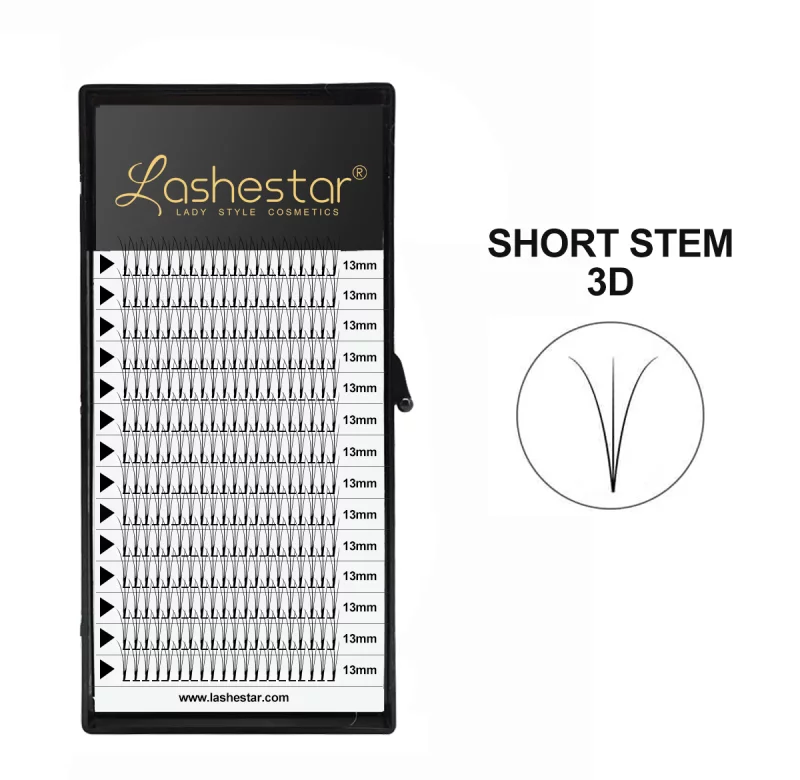
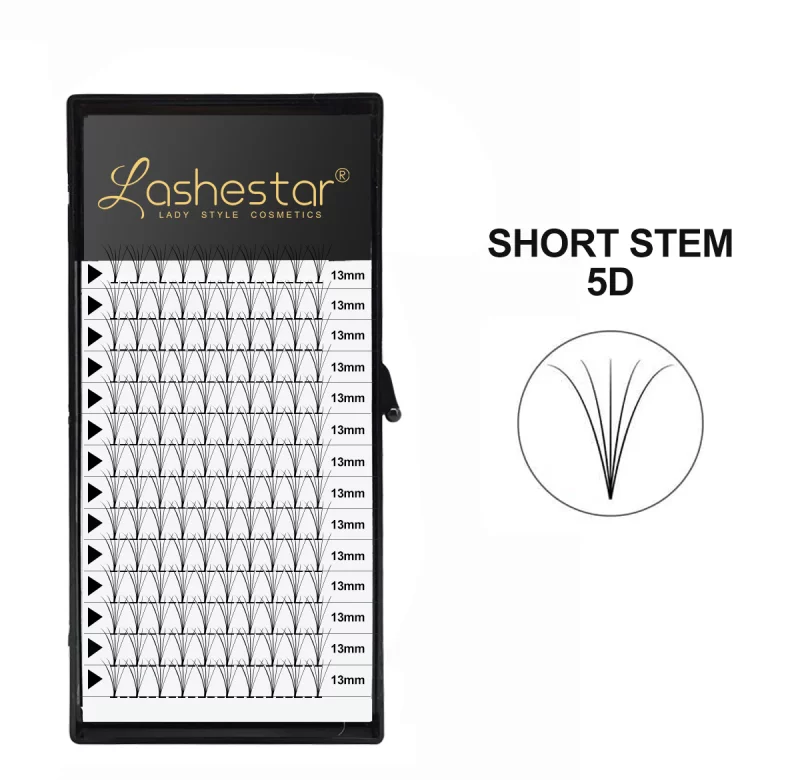
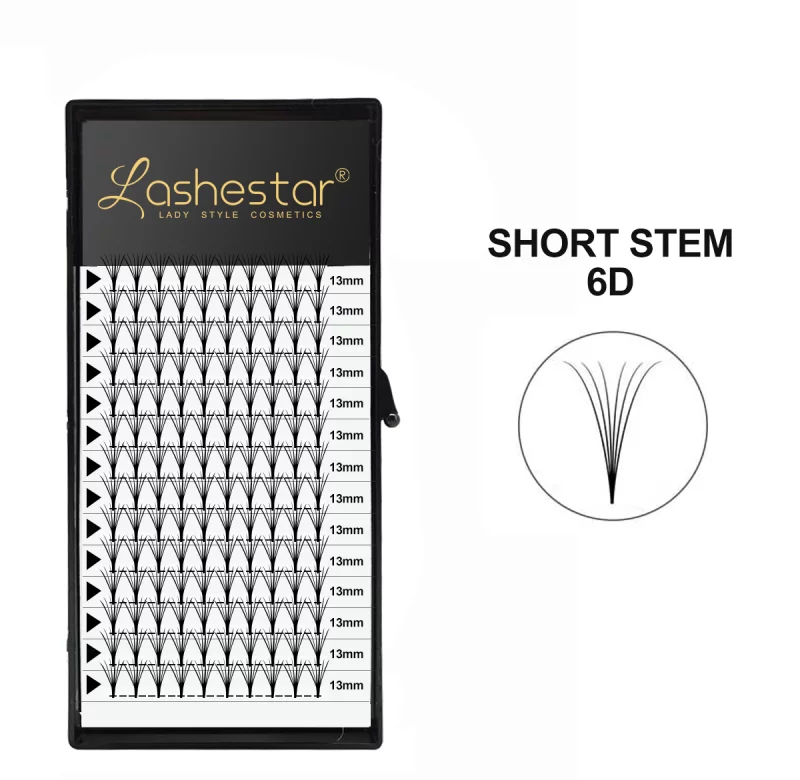
Lashestar’s current catalogue includes 3D Premade Fan Lashes, 5D Premade Fan Lashes and 6D Premade Fan Lashes. The catalogue lists several row-count options. Confirm the exact count-by-pack configuration, curl, lengths and construction in the sample request rather than assuming every possible combination is available as one standard stock item.
The photographs below show actual catalogue products. They identify product families; they are not evidence of a particular client result or a universal loading recommendation. A production-representative sample and written confirmation should settle the final order specifications.
| Product family | Count per fan | Row options listed in the catalogue | Before ordering |
|---|---|---|---|
| 3D premade fans | 3 fibers | 6, 12, 16, 18 or 20 rows | Confirm the specific combination and usable fan count |
| 5D premade fans | 5 fibers | 6, 12, 16, 18 or 20 rows | Confirm mixed or single lengths and row allocation |
| 6D premade fans | 6 fibers | 6, 12, 16, 18 or 20 rows | Confirm construction, curl reference and sample approval |
A product page’s nominal diameter is one field, not a general recommendation for every count and client. Bring any proposed combination to the professional evaluation and confirm the final specification with the supplier. Do not convert a catalogue grid into an automatic application rule.
Why tray rows are a weak purchasing comparison
Two trays with the same number of rows can contain different usable quantities. The layout, spacing and pack format affect what is actually supplied. Ask for the count of finished fans and the method used to verify it.
For mixed-length packs, request the allocation by length as well as the total. A pack can have an attractive total count but still contain too few of the sizes the salon uses most. The relevant purchasing unit is usable stock in the needed specification.
Inspect transit protection and labeling too. A compact pack may be convenient but needs to protect the components. The warehouse should identify count, diameter, curl and length without opening the product or relying on a campaign name.
A row-allocation worksheet
Use a worksheet that separates pack layout from fan construction. The following is an illustrative planning format, not a promised Lashestar stock configuration. Replace the example allocations with the quantities agreed after sampling.
| Field | Example planning entry | Confirmation needed |
|---|---|---|
| Fan family | 5D, approved sample code F-01 | Complete construction specification |
| Pack layout | 12 rows | Usable fans per row and total |
| Length allocation | Short: 2 rows; core: 8 rows; long: 2 rows | Exact millimetres and sequence |
| Curl | One approved reference profile | Physical sample retained with the order |
| Replenishment | Core lengths available separately | Supplier confirmation and ordering codes |
The value of this worksheet is its clarity. The buyer can revise the allocation without accidentally changing the fan. The supplier can flag an unavailable pack combination before the brand approves artwork that describes it.
Build quantities from a salon pilot
Record usage by full specification during a defined pilot period. Count the fans used for the relevant service mix and note handling waste separately. Do not assume every appointment consumes the same quantity or that every length empties at the same rate.
For an illustrative calculation, if a pilot uses 1,200 usable fans of one specification in a month, that figure is the starting consumption estimate. Add the stock needed for the supplier’s confirmed replenishment period and a buffer chosen by the business. Recalculate when the service mix changes; the example is not a standard monthly requirement.
Keep slow-moving accent sizes visible in the report. A large mixed pack may appear to offer more stock while accumulating sizes the salon rarely uses. Compare the operational benefit of mixed trays with the precision of single-length replenishment.
Sample acceptance before private-label artwork
- Confirm the count, nominal diameter, length, curl reference and fan geometry.
- Inspect pieces from several rows or pack positions.
- Evaluate pickup and handling with trained users.
- Confirm the actual usable quantity and mixed-length allocation.
- Approve the pack protection and label fields.
- Retain samples and record the production approval version.
Approve the product before printing a large packaging run. If the fan geometry or pack count changes during development, the artwork needs to remain accurate. A clear version record prevents an old specification from being used for a new batch.
Which fan belongs with which style?
There is no one-to-one rule linking a fan count to a style name. A doll map concerns the location of emphasis. A soft Angel direction concerns the overall texture. Both still require the professional to choose suitable components.
For a branded range, describe the component’s intended role in an approved example: supporting base, softer fill or another clearly specified use. Avoid claiming that one fan automatically creates several finished looks without a map and professional adaptation.
Make the quotation comparable
Send the same specification sheet to each potential supplier. Ask them to mark any difference explicitly: a changed row allocation, a different stem, a substituted curl or a minimum quantity applying to each size rather than the whole order. A quotation that silently substitutes the pack cannot be compared as if it were identical.
Ask whether packaging, label application and sample preparation are included in the proposed scope. Confirm the production and shipping assumptions separately. This keeps the commercial discussion tied to a defined product without requiring a public retail price on the website.
Once the sample is approved, include its code on the purchase specification. If a production change is proposed later, review it before treating the new version as equivalent. The retained sample, accepted pack count and agreed inspection method give both sides a concrete reference.
Keep reorder records specific
Record the lot, product code, pack version and date received. Log missing or damaged components separately from ordinary service consumption. When a salon reports that a pack ran out sooner, the buyer can then distinguish a lower usable count from a change in service demand.
Review the reorder point whenever the service mix changes. A new textured service can alter which lengths are consumed even when the total number of appointments stays similar. The purchasing sheet should follow that change rather than repeat the first launch order indefinitely.
Questions about premade eyelash fans
Are 6D premade fans better than 3D?
They contain more fibers per fan, but “better” depends on the approved brief. Compare all specifications and the intended professional use. Count alone does not establish quality or suitability.
Does a 12-row tray contain a fixed number of fans?
No fixed quantity follows from the row count alone. Request the usable fan count and the mixed-length allocation from the supplier.
Can I order a custom mix?
Ask the supplier to confirm the exact combination, sample process and pack constraints. A catalogue offering custom options does not mean every theoretical configuration is already stocked.
Where should I begin?
Compare the lash extension collection, choose the component families for evaluation and send a written sample request. Return to the styles and types guide if the intended service direction is still being defined.