 View full-size diagram ↗
A lash map for almond eyes should begin with the client’s preferred emphasis, not the assumption that almond eyes must have cat-eye extensions. An almond outline can be discussed with a natural direction, central emphasis or an outer sweep. Lid coverage, natural lash direction and the terminal corner still need separate assessment.
This guide compares those options and explains how to document a cat-inspired map without making the final lashes longest by default. It is a design and purchasing reference for professional consultation, not a universal set of client measurements.
What the almond label does and does not tell you
Almond is commonly used for an elongated eye outline with tapered ends. It does not tell you whether the lid is hooded, whether the outer corner turns upward or downward, or which direction the natural lashes grow. Those observations can change the appropriate design discussion.
Ask the client what they want to preserve or emphasize. Some prefer a balanced outline with little visible change in shape. Others want a more rounded central impression or a longer outer silhouette. A style recommendation should follow that conversation rather than treat the eye-shape label as a command.
Use reference photographs to separate silhouette from density and makeup. A winged liner can make the outer effect seem stronger than the extensions alone. Record the feature the client actually wants, so the map does not promise an appearance created partly by another product.
Compare three directions before selecting a cat eye
| Direction | Area of emphasis | Question to discuss |
|---|---|---|
| Natural-inspired | A gentle rise and fall | Does the client want to preserve the existing outline? |
| Doll/open-eye-inspired | A chosen central area | Does the client prefer more central definition? |
| Cat-inspired | A chosen outer area | Does the client want an elongated outline with a suitable corner finish? |
None of these directions is automatically superior. The map records a visual intention; the actual product and application decisions still depend on professional assessment. A soft version of a style may suit the request better than a dramatic reference.
LashBase’s popular map examples include cat-eye styling among options discussed for almond eyes. That supports considering it, not limiting every almond-eye consultation to it. The central-emphasis guide provides another direction to compare.
Read an illustrative cat-eye map
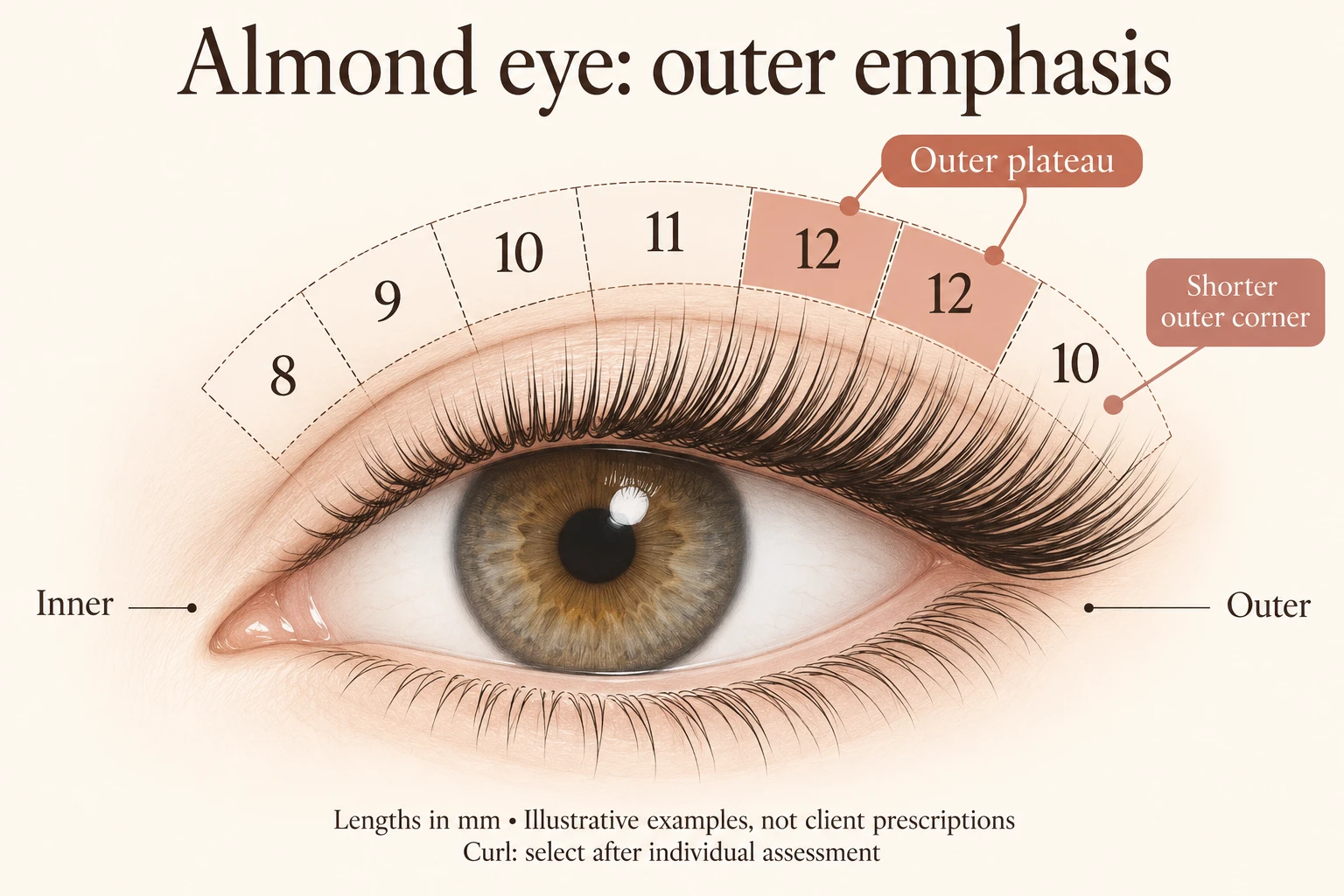
Consider a seven-zone drawing with the hypothetical millimetre sequence 8–9–10–11–12–12–10, read inner to outer. The rise is gradual, the outer emphasis spans two sections and the terminal section is shorter. This is an original schematic example, not a recommendation for every almond eye.
The diagram communicates three decisions: where the increase begins, how broad the peak is and where the taper starts. The actual values may need to be different for an individual client. The chosen curl and the width of each zone also affect the appearance.
If the desired effect is more subtle, the professional may discuss a smaller contrast between sections or a different area of emphasis. Do not assume that shortening every number by the same amount preserves all aspects of the visible result. The complete product profile needs to be considered.
Give the outer corner its own assessment
An almond outline does not guarantee that the terminal lashes are suited to the longest component in the map. Their direction, density and suitability can differ from the adjacent section. The final taper should therefore be a recorded decision rather than an afterthought.
If the last lashes point downward, an outward-emphasis plan may require a different peak location or finish. The purpose is not to force a named map onto the eye, but to identify a design the professional can assess and the client understands.
For a sharper directional request, read the fox-eye mapping guide. Fox and cat-eye terminology overlaps; drawing the peak and the taper communicates more than choosing one label over the other.
Choose curl and construction separately from shape
A cat-inspired length progression can look different with different physical curls. Record the product range and the selected profile, not just the letter. Supplier samples are particularly useful where the map combines a rounded profile with a more directional one.
Construction and density also belong in separate notes. Classic and volume components do not become interchangeable because the map uses the same lengths. The natural lashes and intended professional technique determine appropriate product selection.
Use the curl reference when comparing samples and the premade fan guide where fan construction is part of the brief. Keep the silhouette decision visible without letting it stand in for the entire specification.
Consider lid coverage and both eyes
If the client has an almond outline and a hooded lid, the lid relationship still needs review. A map that looks elongated on paper may be partly concealed when the eye opens. The hooded-eye guide explains how to record the affected area before making changes.
Check each eye rather than relying on a perfectly mirrored diagram. The chosen visual intention can be shared while the notes record a deliberate difference in zone width, profile or peak position. That makes a later appointment easier to review.
Use a normal gaze and similar camera position when recording the agreed appearance. Avoid making new design decisions solely from an angled photograph that exaggerates central height or outer length.
Keep a concise consultation and review record
Write the requested effect, the selected peak area, both corner transitions, the curl reference and the construction. Add any observation that explains a deliberate adjustment. At review, record which parts of the result the client liked and which variable needs reconsideration.
The blank worksheet keeps the two eyes separate. The Lash Map Generator can help organize a digital version using the lengths available in your stock. Neither replaces an assessment of the client’s natural lashes.
Stock the transitions as well as the peak
A cat-inspired service range needs more than its longest tray. Shorter inner lengths, intermediate transitions and the terminal taper all contribute to the outline. Track the actual use of those components before choosing mixed-tray and single-length quantities.
For a brand, specify the approved curl, construction, diameters, lengths, row allocation and packaging. “For almond eyes” is not enough information for manufacturing and should not imply that every client with that outline can use the same products.
Browse the extension collection and use the specification-sheet guide to prepare a sample inquiry. Availability and packaging options should be confirmed for the exact combination requested.
Frequently asked questions
What is the best lash map for almond eyes?
There is no single best map. Compare the client’s preference for a balanced, central or outer emphasis, then assess lid coverage, lash direction and suitable product choices.
Are cat eyelash extensions always suitable?
No. An outer-emphasis style can be considered, but the corner and natural lashes still need assessment. A modified taper or a different direction may better match the request.
Is fox eye just a stronger cat eye?
Some people use the terms that way, but the vocabulary is not standardized. Compare the actual peak, taper, curl and density instead of assuming the name specifies the result.
Return to the Lash Map Guide for the complete series and printable template, or send your approved assortment and packaging requirements through the manufacturing inquiry form.
Keep the original reference and the final recorded version together. A later artist should be able to see which features were retained, which were adapted and why. That makes the map useful for a repeat service rather than simply a picture saved without context.