
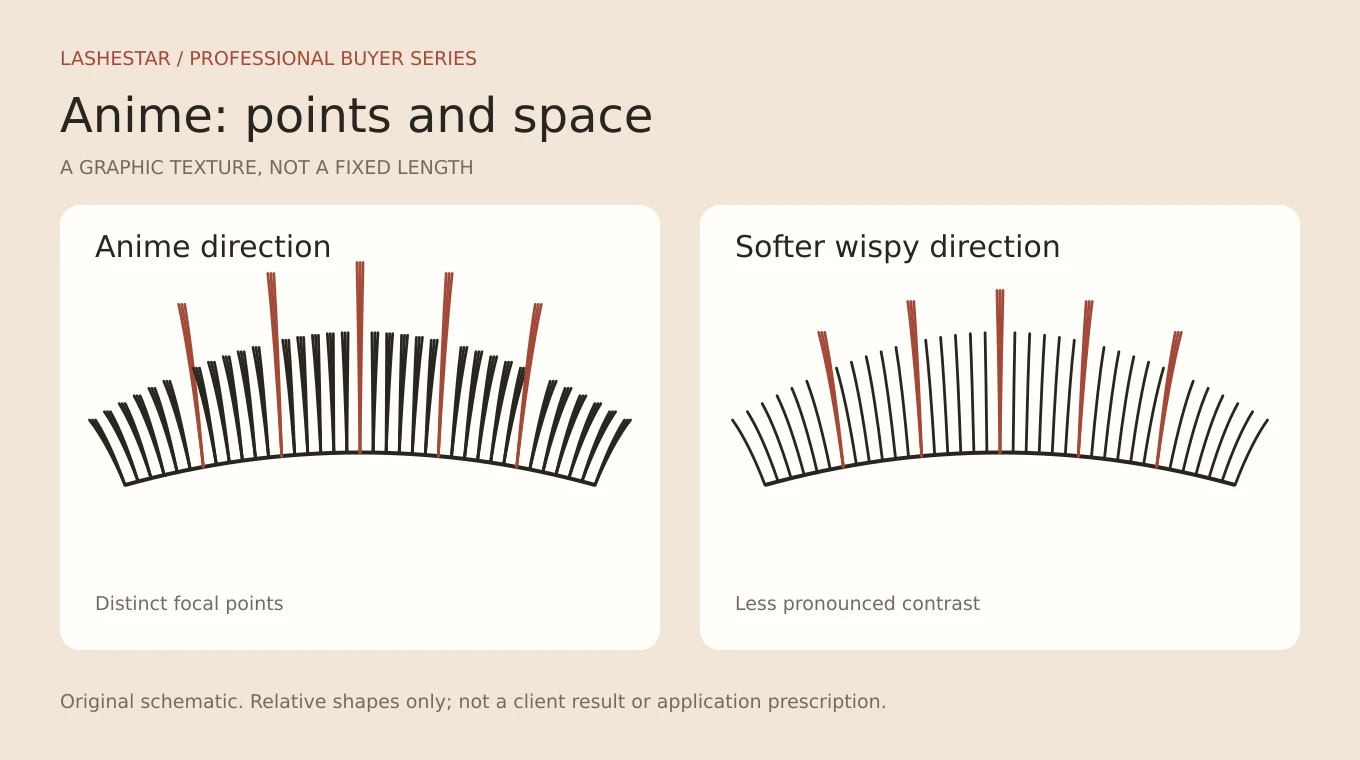
Anime lashes use distinct points and deliberate spacing to create a graphic, illustrated-eye effect. In professional extensions, the look is built through the relationship between prominent accents and shorter supporting sections. The same term is also used for strip lashes and consumer clusters, so a buying conversation must begin by identifying the product format.
For a lash brand, a successful anime range needs more than a striking campaign photograph. The components, map, intended user and replenishment options must agree. This guide explains the visible features, the differences from softer wispy styling, and the information a supplier needs to prepare meaningful samples.
What defines anime lash extensions?
The recognizable feature is a sequence of visible points rather than an uninterrupted fluffy outline. The supporting sections create contrast around those points. Some versions are dramatic, some are restrained, and lower lashes may be included where professionally appropriate. Neither a fixed spike count nor one curl combination defines every version.
London Lash’s manga mapping discussion describes longer accents separated by shorter sections and includes lower lashes as an optional part of the effect. A more recent Shelash tutorial also emphasizes planned points and the space between them. These are examples of practitioners’ approaches, not an international styling standard.
Anime, manga, manhua and manhwa names sometimes overlap in salon menus, but a customer may mean a particular reference rather than a precise technical category. Ask which image she has in mind. Record the requested point definition, spacing and overall silhouette before discussing the physical tray.
Anime versus wispy: compare the rhythm
| Design question | Softer wispy direction | Graphic anime direction |
|---|---|---|
| How obvious are the accents? | Texture may blend into a soft base | Individual points remain clearly identifiable |
| What happens between accents? | Fluffy or fine texture can connect the outline | Separation helps preserve the graphic rhythm |
| What must the brief explain? | How much unevenness and softness is wanted | Where the main points sit and how strongly they contrast |
| What is not fixed? | Method, map and density | Method, map, number of points and lower-lash choice |
The boundary is not absolute. A client can request wispy anime lashes to describe a softer interpretation. Instead of arguing about the label, mark the features that need to remain visible. The wispy and wet-look guide is useful when the reference is more about texture than conspicuous points.
Separate extension systems from consumer formats
A strip lash has a band and is sold as a different application format from individual professional extensions. Consumer clusters also require their own instructions and intended adhesive system. A similar silhouette does not make these products interchangeable, and a brand should not combine their directions in one generic “anime lash” instruction sheet.
For a B2B brief, put the intended user near the top: professional salon, academy or consumer retail. Then identify the construction. If the range is for professional extensions, say whether the components are loose individual fibers, prepared spikes, finished fans or a combination. Ask the supplier to confirm the intended use in writing.
This distinction also matters for packaging photographs. A finished eye can illustrate a style, but buyers need a close view of the actual component and the pack. Show how the item is arranged and labelled, and explain whether it is a base component or an accent component.
Design the map around focal points
Start with the broad silhouette: central emphasis, outer emphasis or a more balanced outline. Next identify the major points, then define the supporting sections between them. The graphic relationship should be readable even in a simple drawing. If the design only works after adding dramatic lighting, the reference may not be specific enough.
A map should show more than a row of numbers. Label the major accent zones, the base region and the intended outer taper. Use separate notes for each eye where needed. Equal spacing on paper does not guarantee equal visual spacing on the open eye, so trained artists must adapt the design to the individual.
The Lash Map Generator can record an illustrative base and accent plan. It is useful for comparing versions and communicating available lengths. It does not assess natural lash condition or determine whether a particular component is suitable for a client.
Negative space is part of the brief
The space around a point helps make that point visible. In a supplier sample review, describe whether the desired reference has a light base, a dark root line, broad filler or narrow filler. These choices can change the appearance without changing the longest size.
If the sample looks like ordinary full volume, first ask whether the supporting texture has obscured the accents. If it looks fragmented, review the relationship between the base and the main points. “More dramatic” is not a useful correction unless the team specifies which part of the design should change.
Photograph comparisons against the same background and at the same distance. Keep an unedited inspection image alongside any polished marketing image. That gives the purchasing team a stable reference when a later batch is compared with the approved sample.
Choose spike and filler components separately
| Role | Sample question | What to record |
|---|---|---|
| Main point | Does the component hold the intended narrow silhouette? | Length, curl reference, width, construction and pickup result |
| Secondary point | Does it support rather than compete with the main point? | Relative size and intended placement |
| Filler | Does its spread preserve the desired separation? | Fan count, spread, base and supporting lengths |
| Short transitions | Can the artist complete the ends coherently? | Available short sizes and curl continuity |
Do not assume a high fiber count makes a better spike. Evaluate the shape and the suitability of the complete component within the professional service. A narrow silhouette, a clean base and consistent pickup are separate requirements; one does not prove the others.
Likewise, a preformed spike should be sampled in the intended workflow. Ask whether the approved construction is maintained across the pack and after pickup. Record damaged or opened components separately from pieces that simply do not match the chosen style.
Curl contrast: test it rather than declaring a rule
Some artists mix curls to change how points project from the base. Others achieve the intended contrast with a more restrained curl selection. The procurement requirement is a reproducible result, not a universal instruction that every spike must be one or two curl letters stronger.
Curl labels vary across manufacturers. A supplier’s L profile is not simply another step on a linear scale after C and D. Compare actual shape samples and document the chosen combination. The curl and specifications series covers that parameter discussion in more depth.
For a new brand, a simpler first assortment can make sample feedback easier to interpret. Add a specialist curl only when testers can identify the distinct effect it provides and confirm that the required neighboring lengths are available for replenishment.
Lower lashes are a separate decision
Lower-lash definition can be part of an anime reference, but it should not be assumed or bundled into every service. Discuss the requested effect separately and let the trained professional assess whether and how it belongs in that appointment. A catalogue diagram is not a lower-lash application tutorial.
From the product side, record a separate component and intended-use brief if lower-lash materials are required. Do not reuse an upper-lash pack description without checking the construction and instructions. For marketing, show clearly whether the photographed result includes lower-lash work so buyers understand what they are viewing.
Position the range for the actual audience
A specialist salon serving clients who request graphic points may need a different assortment from a general salon introducing one softer anime option. Interview the intended testers before building the range. Ask which references recur, which lengths they already stock and where their current components fall short.
For an academy, the supporting material might prioritize component identification and map recording. For an established brand, the focus might be consistent replenishment across existing stock codes. Avoid adding a broad catalogue of variants before those practical needs are understood.
Search popularity alone does not establish demand in a particular salon or market. Use inquiry records, tester feedback and actual reorder behavior to decide whether a specialist line deserves more sizes. A trend can justify a controlled pilot; it does not automatically justify a large stock commitment.
Run a sample pilot with a written decision sheet
- Identify the intended user and application format.
- Select authorized reference images showing the desired point definition.
- Separate base, main accent, secondary accent and transition components.
- Give each supplier sample a code and record the complete specifications.
- Collect professional feedback on handling and the intended result.
- Compare the appearance in a consistent open-eye view.
- Record consumption by component before finalizing the mixed-tray allocation.
Ask reviewers to distinguish “wrong for this design” from “manufacturing defect.” A soft, widely spread fan can be excellent for another service yet unsuitable for the intended filler. That distinction makes revisions faster and protects a useful component from being rejected for the wrong reason.
Prepare a catalogue that answers buyer questions
Include a tray photograph, a close component view and an accurately labelled style illustration. Describe the contents with length, curl, nominal diameter, construction and count. Explain which information is fixed and which options require sample confirmation. Keep the marketing name secondary to the ordering code.
A pack marked “anime mix” should also show the actual row allocation. Otherwise, a repeat buyer cannot know whether it contains more filler, more accents or different lengths than the previous version. Version the pack specification when the contents change, even if the campaign name stays the same.
Questions about anime lashes
Do anime lashes need a doll-eye map?
No. A centrally emphasized map is one possible direction, but the graphic texture can be combined with different silhouettes. Start with the requested effect and the individual assessment. See the doll lash guide for the central-emphasis option.
Are anime and manga lashes exactly the same?
The names overlap in common salon language, but they are not standardized product specifications. Confirm the reference image and component plan. A buyer should not assume two suppliers mean the same construction simply because the style labels match.
Does the style require very long extensions?
The graphic effect depends on contrast and spacing, not just maximum length. The appropriate specifications must be assessed professionally. A shorter interpretation can still preserve distinct points when the base and accents are designed coherently.
What should a sample request contain?
State the intended user, professional or consumer format, reference effect, component roles, required size range and pack plan. Ask for construction details and a production-representative sample before approving a private-label version.
Use the complete styles and types guide to compare adjacent directions. Browse the lash extension collection and discuss a sample brief with Lashestar when the required components are defined.