
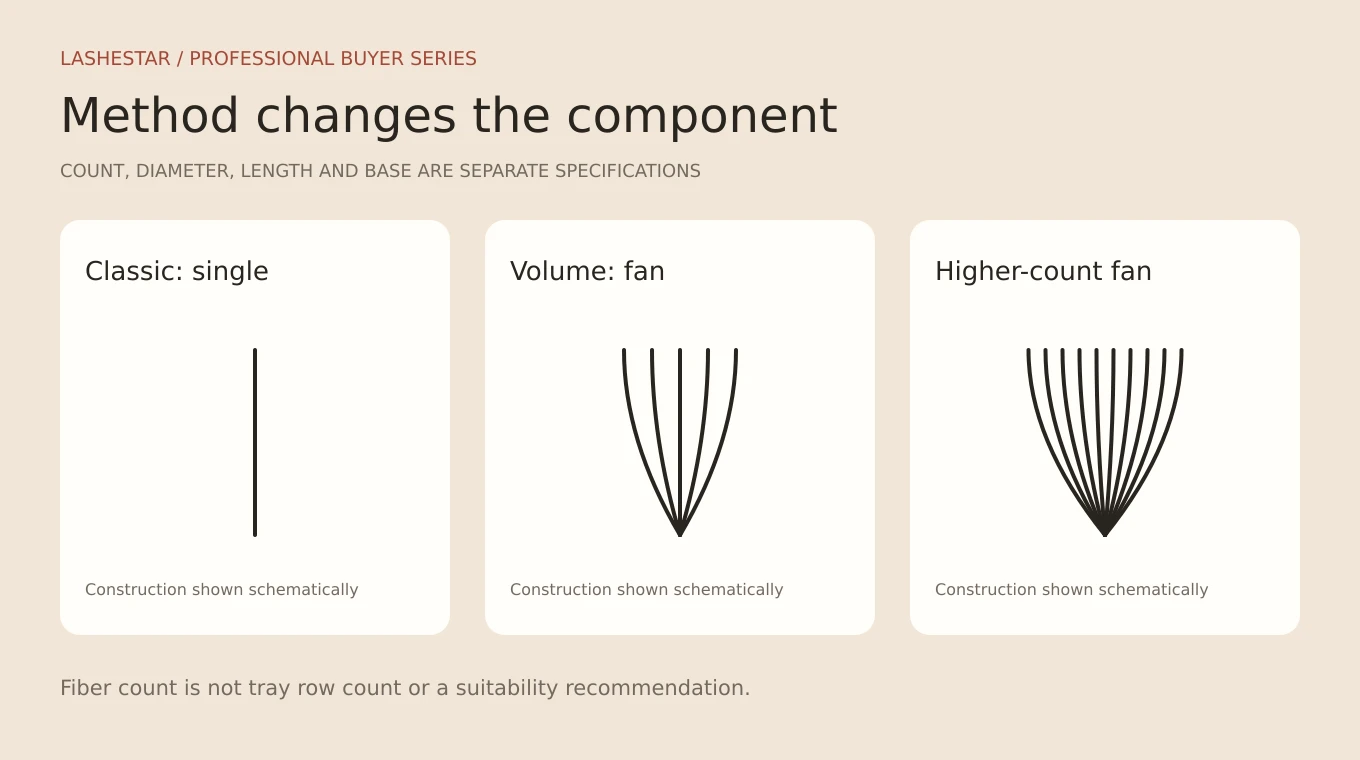
Russian lashes usually refers to volume extensions built with fans of fine fibers. Classic application uses one extension on a suitable isolated natural lash; volume uses a fan on one suitable natural lash. Mega volume generally describes a denser volume approach using finer fibers and higher fan counts, but the boundary is not a universal number.
For a professional buyer, these service names are the start of a conversation. The ordering specification still needs diameter, length, curl, fan count, spread, base construction and pack details. This guide separates the method from the finished look so a brand can source the components it actually needs.
Russian volume is not an eye map
A volume method can support different silhouettes. The artist can create central emphasis, outer emphasis or a more balanced outline. A smooth result and a textured result also require different design choices. Calling a service Russian lashes does not tell the purchasing team where the longest sizes go.
Traditional Russian volume is often associated with a carefully even top line. Modern salon menus may use the label more broadly. Ask whether the customer means the fan technique, a smooth finish or simply a fuller service. The styles and types guide separates those three meanings.
Classic, Russian volume and mega volume compared
| Method | Component | Diameter discussion | What the name does not prove |
|---|---|---|---|
| Classic | One extension per suitable natural lash | Confirm the single fiber’s nominal diameter and profile | Identical density on every client |
| Russian / volume | A multi-fiber fan per suitable natural lash | Fine fibers; 0.05 and 0.07 mm are examples of supplier categories | A fixed fan count or a particular eye map |
| Mega volume | A higher-density fan approach | Very fine categories such as 0.03 mm appear in supplier ranges | One universal threshold or automatic suitability |
These are catalogue examples, not load recommendations. LashBase lists a 0.03 mm mega-volume category; London Lash lists 0.07 mm volume fibers. The categories illustrate market language, not permission to build any fan count from any diameter.
Why the D number is not enough
In fan terminology, 3D, 5D and 6D identify the number of fibers in one fan. They do not identify curl, tray rows or complete fan mass. Two 5D products can differ in length, individual diameter, taper, base and spread.
A buyer comparing only the count can miss a significant construction difference. Ask for a specification and a close component image, then compare physical samples. The practitioner still assesses the individual natural lash and the complete component; a catalogue table cannot make that decision.
For ordering and pack examples, use the premade lash fan guide. Keep the fan count visible in the stock code, but do not let it replace the other specifications.
Handmade fans and premade fans
Handmade fans are prepared by the artist during the professional workflow. Premade fans are formed before the service. Suppliers may use “promade” to emphasize hand preparation, but naming practices differ. Ask what is supplied and how it is constructed rather than assuming the label settles the question.
A finished fan can make a particular workflow more convenient, while individual fibers allow the trained artist to vary fan construction. The better choice depends on the user and service. Test pickup, consistency, placement workflow and the approved result instead of promising a fixed reduction in appointment time.
For a salon group using both formats, separate their inventory and training descriptions. Staff should be able to identify whether a tray contains individual volume fibers or finished fans without opening the pack and guessing from the marketing name.
Fan spread and base shape change the brief
A narrow fan and a wider fan distribute fibers differently. The appropriate choice follows the intended texture and the professional assessment. In sampling, specify whether the brand wants a softly spread base, a more defined line or a component for a particular textured design.
Compare the stem and bond area closely. Ask the supplier to identify the construction and retain samples showing acceptable variation. A neat photograph of a single fan cannot demonstrate pack consistency; inspect several pieces across the sample pack.
Separate dimensional feedback from handling feedback. A fan may match the requested width but open or distort during pickup. Another may handle well but have a spread that conflicts with the intended look. Those are different revision requests.
Build a range around service demand
Start with the methods your customer base already uses. An academy teaching hand-fanning may need a different assortment from a salon group standardizing finished fans. A brand serving both should explain the distinction and give each range clear ordering codes.
Choose a limited sample matrix before multiplying every combination of diameter, count, curl and length. Test the core options, identify the repeated requirements, then expand deliberately. A large theoretical catalogue can become difficult to replenish when actual demand concentrates in a few combinations.
Track consumption by complete SKU. “Volume lashes” is too broad for replenishment because a missing curl in one length can disrupt a planned service even when the shelf contains many other trays. Review the short sizes as well as the visible long sizes.
A receiving inspection checklist
- Match the stock code, count, diameter, curl and length to the approved order.
- Compare the curl and finish with retained samples under consistent light.
- Inspect fan symmetry, spread and base construction across several positions.
- Test pickup using the agreed professional evaluation method.
- Count usable components when the pack is sold by finished-fan quantity.
- Record defects by lot and keep handling preferences separate from defects.
Agree the sampling method and acceptance criteria before the bulk order. A supplier and buyer can both use the word “consistent” while expecting different tolerances. Photographs, retained samples and written criteria make that expectation reviewable.
When a volume range supports textured styles
Volume components can be used in a wispy design or a centrally emphasized doll map, but the method alone does not create the texture or silhouette. Keep the usage example separate from the physical specification.
For a brand, this allows one well-defined component family to support several service examples. It also avoids confusing repeat buyers with several product names for the same tray. Add a distinct item when its construction or contents actually differ.
Questions about Russian lashes
Is Russian volume always handmade?
The traditional technique centers on artist-made fans, while contemporary menus and product ranges also use volume terminology for finished fans. Ask the salon or supplier which construction and workflow it means.
Does mega volume start at a fixed D count?
There is no universal boundary that makes every supplier’s labels comparable. Check the complete specification and intended professional use. Do not infer suitability from the word “mega.”
Are more fibers always a better product?
No. The useful product is the one that meets the approved professional brief consistently. Count is only one attribute alongside diameter, length, base, spread and handling.
How should a wholesale request be written?
State the intended method, component format, complete specifications, pack allocation and sample criteria. Browse Lashestar extension products and send the requirement for review before finalizing a private-label range.